China Top ESD Safe Flooring Manufacturers for Global Buyers
Choosing the right Esd Safe Flooring manufacturer in China requires more than comparing prices. Global buyers must examine technical performance, production experience, quality systems, and after-sales support. A floor may look smooth and durable, yet fail under real static-control demands.
This guide introduces leading China-based manufacturers serving international projects. It considers product types, including conductive vinyl, dissipative tiles, raised access flooring, and epoxy systems. It also reviews resistance ranges, surface wear, installation methods, and available testing documents. In practice, these details matter. A laboratory certificate alone does not guarantee consistent performance across a large facility.
Experience matters on site. Good manufacturers can explain grounding layouts, maintenance routines, climate-related risks, and compatibility with cleanroom or electronics environments. They should also provide traceable samples, factory information, inspection records, and clear warranty terms. Buyers may request independent testing before shipment.
Not every supplier deserves the same confidence.
Some company profiles are difficult to verify. Product data may also change between batches. This is an important limitation, not a minor detail. Buyers should confirm current certifications, production capacity, export experience, and project references directly with each manufacturer. Local installation conditions must receive equal attention.
The following overview is designed to support a careful shortlist. It does not replace engineering review or on-site testing. Instead, it offers a practical starting point for comparing China’s Esd Safe Flooring manufacturers with greater clarity, caution, and professional judgment.
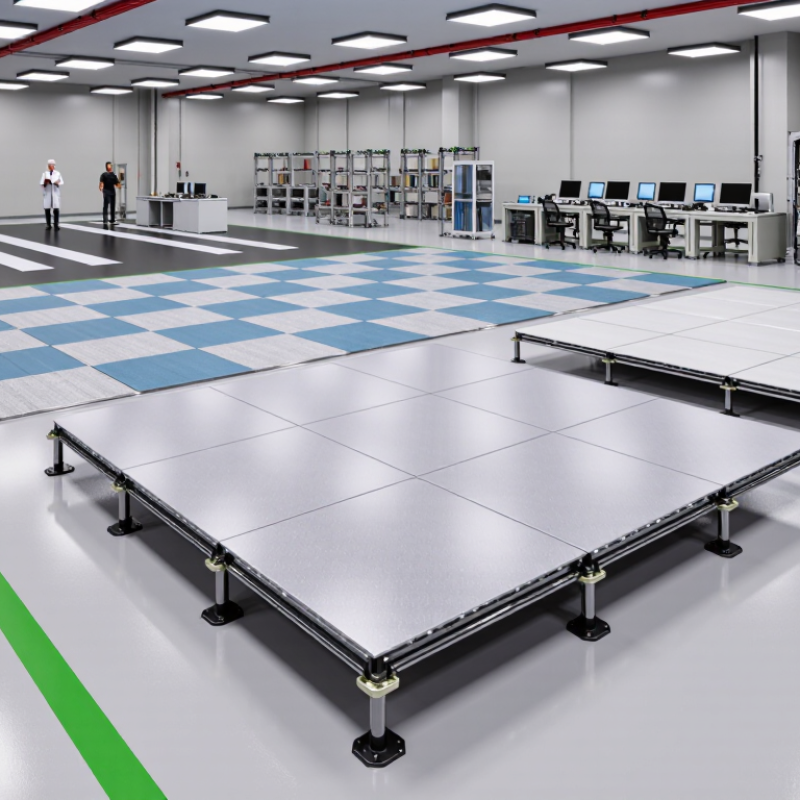
What Is ESD-Safe Flooring and Why Does It Matter?
What Is ESD-Safe Flooring and Why Does It Matter?
Electrostatic discharge can damage sensitive circuits without visible sparks or immediate failure. ESD-safe flooring controls this charge and guides it toward a verified ground path. In practical terms, a technician walks across a cleanroom floor, and charge moves away instead of accumulating on shoes or clothing.
IEC 61340-5-1 identifies resistance control as a core requirement for protected electronic areas. Its commonly used resistance range is 1.0 × 10⁴ to below 1.0 × 10⁹ ohms, depending on the tested system.
ANSI/ESD S20.20 also stresses a complete program, not flooring alone. The ESD Association’s TR53 recommends regular compliance verification, including resistance and grounding checks. A floor may pass today and fail later.
Material choice matters. Conductive vinyl, rubber, and raised access systems can provide different resistance, durability, and maintenance results. Moisture, floor finish, footwear, seams, and grounding hardware all influence performance.
Global buyers should request test methods, measured values, batch records, and installation guidance from manufacturers. Ask for evidence under actual site conditions.
The weak point is often installation.
A technically compliant product can underperform when joints are poorly sealed or grounding points are ignored. From field experience, cleaning chemicals and heavy traffic deserve early review.
Independent testing remains sensible, especially for laboratories, data centers, and electronics assembly rooms. Data sheets help, but measured site performance matters more.
Key Types of ESD-Safe Flooring for Industrial Applications
Industrial facilities need flooring that controls static electricity without sacrificing safety, durability, or cleaning performance. The main choices include conductive epoxy, static-dissipative vinyl tiles, conductive rubber, and ESD-safe coatings. Conductive epoxy creates a seamless, chemical-resistant surface for electronics plants and controlled production rooms. Vinyl tiles offer easier replacement and flexible installation. Rubber flooring provides comfort underfoot and useful resistance to impact.
Selection depends on resistance range, traffic, moisture, chemicals, and grounding design. Conductive systems often measure around 10⁴ to 10⁶ ohms, while dissipative systems commonly fall between 10⁶ and 10⁹ ohms. Actual limits depend on the project standard. Site testing should follow recognized requirements, such as IEC 61340-5-1 or ANSI/ESD S20.20. In practical inspections, installers sometimes focus too much on the flooring material. The grounding network matters just as much. A perfect specification can still fail after poor joints, dust, or damaged copper tape.
Tips: Check substrate moisture before installation. Confirm resistance after curing. Test several points, not only one convenient area. Keep records for future audits. Ask manufacturers for technical data, installation conditions, and repair guidance. A clean appearance does not prove ESD performance. Periodic testing remains necessary, especially near entrances, workstations, and wheeled equipment. Some projects also need compatible footwear and grounded personnel systems. This detail is often missed.
China Top ESD Safe Flooring Manufacturers for Global Buyers - Key Types of ESD-Safe Flooring for Industrial Applications
The chart shows commonly specified surface-resistance bands for ESD flooring systems. Conductive flooring is typically specified at 10⁴–10⁶ ohms, while dissipative flooring is commonly specified at 10⁶–10⁹ ohms. The insulative range above 10⁹ ohms is included as a reference and is generally unsuitable for controlled ESD work areas without additional grounding and compliance measures. Actual performance depends on installation, grounding, humidity, footwear, maintenance, and the applicable standard.
Reference framework: commonly used resistance classifications aligned with ANSI/ESD flooring and grounding practice.
How to Evaluate China-Based ESD Flooring Manufacturers
China Top ESD Safe Flooring Manufacturers for Global Buyers
Evaluating China-based ESD flooring manufacturers requires more than comparing prices. Examine factory experience, production capacity, and quality controls. Ask how conductive tiles, vinyl sheets, adhesives, and copper strips are tested together. A flooring system may meet resistance targets in a laboratory, yet perform poorly after installation. Request recent test reports from qualified laboratories, not only internal inspection sheets. Confirm the testing method, product thickness, humidity conditions, and applicable standards.
Visit the factory online or in person when possible. Check mixing equipment, curing areas, packaging, and batch traceability. Request production samples from different lots. Inspect color consistency, surface texture, edge accuracy, and welding quality. Ask for installation guidance and maintenance records. Export experience also matters. Reliable manufacturers should explain lead times, loading protection, documentation, and after-sales procedures clearly. Vague answers deserve attention.
Tips: Test a sample area before placing a large order. Measure resistance after cleaning and under realistic humidity. Check whether installers understand grounding layouts. Do not accept impressive photographs as technical evidence. I would also compare at least three suppliers, although this takes time. One overlooked issue can become an expensive repair. Suppliers should admit product limits and recommend suitable applications, rather than promise universal performance.
Manufacturing Standards, Testing, and Quality Certifications
China’s leading ESD-safe flooring manufacturers should prove performance through controlled production, not attractive brochures. Buyers need documented recipes, calibrated equipment, and traceable batch records. Common systems include conductive vinyl, rubber, epoxy, and raised access floors. Each requires different installation controls. IEC 61340-5-1 and ANSI/ESD S20.20 provide useful references for electrostatic protection programs. However, flooring alone does not create a compliant workstation.
Reliable suppliers test resistance to ground and point-to-point resistance on finished samples. They should also measure walking voltage, charge generation, surface wear, moisture response, and dimensional stability. Testing must represent real conditions. Use the specified adhesive, subfloor, cleaning method, and footwear. Independent laboratories operating under ISO/IEC 17025 add credibility to reported results. Factory laboratories remain valuable for daily control, but they should not replace impartial verification. Small details matter.
Global buyers should review ISO 9001 quality systems, environmental controls such as ISO 14001, and product-specific fire or slip reports. Check certificate scope, issue date, test method, sample identification, and manufacturing address. A logo on a certificate is not enough. Ask whether the tested formula matches the shipped formula. Factory audits can expose inconsistent copper strip placement, uneven conductive layers, or weak packaging. These findings deserve correction, not excuses. Transparent corrective-action records often reveal more maturity than a flawless sales presentation.
Global Purchasing, Customization, and Export Considerations
China Top ESD Safe Flooring Manufacturers for Global Buyers
Global Purchasing, Customization, and Export Considerations
China-based ESD flooring manufacturers supply conductive PVC, rubber, and raised-access systems for international projects. Material selection should match room use, trolley traffic, humidity, and cleaning chemicals. A factory sample helps. It is not enough. Request resistance data, wear results, dimensional tolerances, and installation instructions from a recent production batch. Test reports should show the method, testing date, and sample details.
Customization may include colors, tile sizes, edge treatment, carton design, and pallet labels. Send accurate drawings with clear tolerances and packing marks. Confirm minimum order quantities, tooling charges, and sample fees before production. Approve a pre-production sample in writing. Small details matter. A slight color mismatch can delay a cleanroom handover. Check adhesive compatibility and grounding layouts with a qualified local installer, because flooring alone cannot provide complete ESD protection.
Export planning requires careful document control. Confirm Incoterms, carton dimensions, gross weight, lead time, payment milestones, and inspection rights. Request commercial invoices, packing lists, certificates of origin, test reports, and destination-specific documents. Moisture-resistant packaging is important during long sea transport. Independent inspection can verify quantity and visible defects before shipment. The lowest quotation may conceal replacement costs or limited support. I would still challenge my checklist: test reports can become outdated, and stated compliance does not guarantee performance on site.
 skip to Main Content
