skip to Main Content
The search for the Best China Electric Lawn Riding Mower Suppliers begins with evidence, not attractive catalog images. Global market reports from Grand View Research and Fortune Business Insights identify battery-powered outdoor equipment as a growing segment. Their forecasts differ, however. That difference deserves attention. Market estimates often depend on product definitions, regional coverage, and commercial assumptions.
The U.S. Department of Energy reports that electric motors can convert more than 75% of electrical energy into movement. Conventional gasoline engines typically convert only 20% to 30%. This efficiency gap matters when a riding mower covers large lawns, parks, resorts, or commercial estates. Lower noise, fewer routine engine parts, and cleaner operation also influence purchasing decisions. Still, battery replacement costs and charging infrastructure can change the real ownership calculation.
Kris Kiser, president and CEO of the Outdoor Power Equipment Institute, has described battery equipment as “quieter, easier to use, and requiring less maintenance.” His observation reflects a practical shift, but it should not end the evaluation. A serious supplier must provide battery specifications, cutting width, motor output, charging time, warranty terms, and documented safety testing. Factory photographs are not enough.
Some suppliers publish impressive range figures under ideal conditions. Wet grass, slopes, heavy loads, and cold temperatures may produce different results. That is the uncomfortable part. Buyers should request field-test records, spare-part availability, and service response times before signing an order. The strongest China Electric Lawn Riding Mower suppliers combine manufacturing capacity with transparent data, traceable quality control, and realistic performance claims.
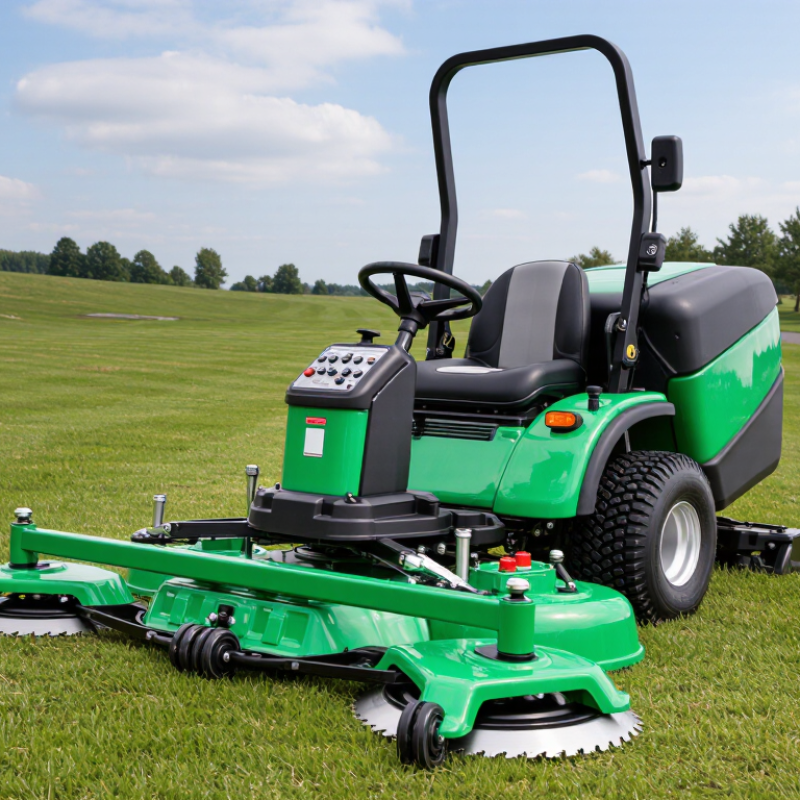
China-made electric lawn riding mowers come in several practical forms. Compact rear-engine models suit small residential lawns and narrow gates. Their cutting decks are often 30 to 38 inches wide. They usually offer simple controls, modest battery capacity, and easy storage.
Lawn tractors provide a more balanced option for larger gardens. Their front-mounted decks improve visibility around trees and flower beds. Many use removable lithium-ion battery packs, while some use fixed battery systems. Zero-turn electric mowers work faster on open, flat ground. Independent rear-wheel motors help them turn within their own length. They can feel less comfortable on slopes, though. Stand-on models are another type, combining a compact frame with a raised operator platform. They improve visibility but may require more balance.
When comparing Chinese suppliers, I examine the battery management system, motor cooling, charger protection, and deck construction. Ask for verified testing records, production photos, warranty terms, and spare-parts availability. A clear service process matters more than a polished catalog. I also check whether the mower has been tested on wet grass, uneven ground, and repeated stop-and-start work. A specification sheet can hide practical weaknesses. I once found that a lighter mower handled well, but its deck clogged quickly in damp grass. That was not a small detail. Suppliers should explain rated cutting time, charging conditions, slope limits, and maintenance intervals in plain language.
Typical cutting-width ranges commonly listed for China-made electric riding mower categories. Values are indicative, brand-neutral market ranges in centimeters.
Electric lawn tractors are generally suited to residential and light commercial lawns, while zero-turn and stand-on models typically provide wider cutting decks and higher productivity for larger properties.
Comparing Chinese mower suppliers requires more than checking motor power or catalogue photos. Ask for battery chemistry, rated capacity, charging time, and expected cycle life. A useful supplier should provide test records, not vague promises. During demonstrations, inspect cutting consistency on wet and uneven grass. Listen for motor noise, belt vibration, and sudden speed changes. Quiet operation matters near homes.
The deck material and cutting width affect durability and productivity. Steel decks can handle rough use, while lighter materials may reduce energy demand. Check blade access, corrosion protection, tire grip, turning radius, and seat adjustment. Small details become important after several hours of mowing. One polished test run can mislead. Repeated trials on different slopes reveal more.
Support quality also separates reliable suppliers from risky choices. Confirm spare-part availability, battery replacement procedures, warranty limits, and response times. Request manuals with wiring diagrams and clear maintenance intervals. Ask whether the supplier can adapt chargers to your local electrical system. Independent safety documentation deserves careful review. A low purchase price may hide expensive battery shipping or delayed repairs. Some specifications may still need verification before a purchase decision.
When evaluating China electric lawn riding mower suppliers, inspect more than a clean showroom. Request production records, material specifications, and recent quality reports. Check whether welds are uniform, wiring is protected, and battery compartments resist dust and moisture. A practical sample test should measure cutting performance, braking response, steering accuracy, noise, and charging time.
Certification documents need careful verification. Ask for certificate numbers, issuing laboratories, test standards, and matching model numbers. CE marking may support European market access, but it does not replace technical documentation or factory controls. For battery systems, review transport test records, protection settings, and thermal safety procedures. ISO 9001 can indicate a quality system, yet it cannot prove every mower is reliable. Documents can look impressive.
Production capacity requires physical evidence. Walk through machining, welding, painting, battery assembly, and final inspection areas. Count active lines, trained workers, testing stations, and finished units waiting for shipment. Ask for monthly output, peak-season capacity, lead times, and backup suppliers for controllers or motors. Compare these figures with purchase forecasts. A factory claiming high capacity may outsource critical assembly without clear disclosure. That matters.
Request a pilot order before signing a large agreement. Inspect several units from different production dates, not only one carefully prepared sample. Review defect rates, corrective-action records, spare-parts availability, and warranty response times. Even experienced buyers can trust a polished factory tour too quickly. Independent inspection is often worth the extra cost.
| Evaluation Dimension | Key Data Point | Recommended Acceptance Benchmark | Evidence to Request | Suggested Weight |
|---|---|---|---|---|
| Legal Manufacturing Status | Business registration and manufacturing scope | The registered business scope should cover machinery, electrical equipment, garden equipment, or an equivalent manufacturing activity. | Business license, registered address, factory address, ownership information, and export authorization where applicable. | 5% |
| Factory Verification | Production site authenticity | The production address, equipment, workforce, and assembly areas should match the supplier's declared factory profile. | Recent factory audit, dated production-line photographs or video, machinery list, facility floor plan, and on-site or live video inspection. | 8% |
| Quality Management | Quality management system | A current ISO 9001 certificate should cover the relevant manufacturing site and product-related scope. | Certificate number, issuing body, validity dates, scope, audit status, incoming inspection records, in-process inspection records, and final inspection reports. | 10% |
| Environmental and Safety Management | Operational management systems | ISO 14001 and ISO 45001 are useful indicators for environmental controls and occupational health and safety when required by the buyer or project. | Valid certificates, scope confirmation, environmental permits where applicable, safety procedures, training records, and incident-control procedures. | 5% |
| Product Compliance | Target-market conformity | For the European Economic Area, the complete mower configuration should have applicable CE conformity documentation, including relevant machinery, electrical safety, EMC, and RoHS requirements. | EU Declaration of Conformity, technical file index, risk assessment, EMC test report, electrical safety test report, RoHS material declaration, and product labels. | 12% |
| Battery Safety | Traction battery and charger compliance | Lithium battery shipments should have UN 38.3 transport test evidence. Cell and battery safety testing should be selected according to the battery chemistry, construction, and target market. | UN 38.3 test summary, battery specification, BMS protection parameters, charger specification, fire-safety procedure, and applicable IEC or national test reports. | 12% |
| Electrical and Mechanical Design | Drive system, cutting system, and protection features | The design should include overload protection, emergency stop or equivalent safe stopping function, guarded moving parts, stable braking, and documented ingress-protection claims where specified. | Electrical schematics, motor and controller specifications, braking test results, safety-function test records, CAD drawings, and user manual. | 10% |
| Production Capacity | Verified monthly output | Capacity should be demonstrated using actual line data. A suitable supplier should have enough verified monthly capacity to cover forecast demand plus a practical contingency margin. | Capacity calculation, production-line layout, equipment list, labor allocation, recent production records, and utilization data for the same or comparable product. | 8% |
| Lead Time Control | Sample and mass-production lead time | The supplier should provide separate lead times for engineering samples, first production, repeat orders, battery procurement, and peak-season orders. | Written production schedule, material lead-time list, bottleneck analysis, purchase-order history with confidential information removed, and recovery plan for delays. | 7% |
| Supply-Chain Stability | Critical component sourcing | The supplier should identify approved sources and alternatives for batteries, motors, controllers, chargers, transmissions, tires, and cutting assemblies. | Approved vendor list, dual-source plan, incoming component inspection standards, change-control procedure, and notice period for component substitutions. | 7% |
| Product Testing | Functional and durability validation | Testing should cover cutting performance, driving, braking, slope operation, charging, thermal behavior, vibration, noise, water exposure where claimed, and repeated-use durability. | Test plan, acceptance criteria, test equipment calibration records, test samples, test results, failure analysis, and corrective-action reports. | 8% |
| Traceability | Serial numbers and production records | Each mower and battery pack should be traceable to production date, key components, inspection results, and shipment batch. | Serial-number format, barcode or QR-code process, batch records, battery lot records, inspection logs, and recall or containment procedure. | 5% |
| After-Sales Capability | Warranty and spare-parts support | The supplier should provide a written warranty policy, spare-parts list, troubleshooting process, repair guidance, and response-time commitment. | Warranty terms, parts catalog, exploded-view drawings, service manuals, diagnostic procedures, response-time SLA, and historical claim process. | 6% |
| Commercial Reliability | Quotation transparency and change control | The quotation should clearly separate mower, battery, charger, spare parts, packaging, tooling, testing, shipping terms, and any recurring fees. | Itemized quotation, payment terms, Incoterms, tooling ownership terms, engineering-change policy, packaging specification, and approved pre-production sample. | 5% |
| Total Recommended Evaluation Weight | 100% | |||
Choosing the best China electric lawn riding mower supplier requires more than comparing unit prices.
Grand View Research estimates the global electric lawn mower market will expand steadily through 2030, driven by battery adoption and lower operating costs. However, a low quotation may exclude batteries, chargers, spare blades, packaging, or sea freight. Compare EXW, FOB, and landed costs in the same spreadsheet.
Cheap is not cheap.
Customization can include cutting width, battery capacity, seat design, dashboard language, and private-label packaging. Ask about minimum order quantities, tooling charges, sample fees, and software ownership.
A practical trial should test wet grass, slopes, charging time, and emergency stopping. The IEC 62841 series offers useful reference points for powered garden machinery, although local compliance still needs checking.
My first comparison was too simple. I focused on horsepower and missed spare-part availability.
Warranty terms deserve precise wording.
Request separate coverage for the motor, controller, charger, battery, frame, and drive axle. Battery warranty periods may differ sharply from vehicle warranties.
Battery terms matter.
A reliable supplier should provide fault codes, repair videos, parts lists, and response targets. The 2024 MarketsandMarkets analysis identifies battery performance and charging infrastructure as important growth factors in electric outdoor equipment.
Therefore, ask for tested cycle-life data, not only advertised range. A 24-month warranty sounds strong, but it means little without replacement procedures, trained technicians, and stocked parts. Quarterly service reviews can reveal whether after-sales promises work in practice.
Choosing a Chinese supplier requires more than comparing online prices. Start by defining mowing area, terrain, cutting width, battery range, and expected weekly use. A small test plot can reveal practical weaknesses.
Request factory videos, production records, and a live inspection before placing an order. Check motor output, battery-cell documentation, charger protection, frame welding, and waterproof connectors. Ask for a sample mower under real grass conditions. Test it on slopes, wet patches, tight turns, and uneven ground. Measure runtime, charging time, cutting consistency, and operator comfort. Numbers matter.
A polished factory tour can mislead. I have learned that a clean showroom proves little about long-term support. Verify the supplier’s quality-control steps and inspect random finished units. Confirm applicable safety documents for your destination market, along with battery shipping paperwork. Discuss minimum order quantities, replacement parts, warranty response times, packaging strength, and clear payment terms. Put every promise into the contract. Vague language creates expensive disputes. Request a video call with the production manager, not only a salesperson. Ask how faults are recorded and corrected. A supplier that welcomes difficult questions often deserves closer attention, although trust should still be tested through a paid sample and independent inspection. Compare at least three factories using the same checklist. The cheapest offer may hide weaker cells, limited parts, or inconsistent assembly.
