Top 10 Automatic Glass Cutting Machines for Global Buyers
Buying the right Automatic Glass Cutting Machines requires more than comparing cutting speed and advertised prices. Global buyers must examine the complete production environment: glass thickness, sheet dimensions, coating types, loading methods, software compatibility, and local service support. A machine cutting 6-millimeter clear glass smoothly may struggle with laminated, Low-E, or oversized panels.
Glass-processing engineer Dr. Markus Hegger once said, “A cutting line earns its value through repeatable accuracy, not impressive speed.” This principle remains practical on a busy factory floor. A clean score line, stable bridge movement, and controlled breaking process can reduce edge damage, glass waste, and operator intervention. Small details matter. Even the suction cups matter.
This guide reviews the Top 10 Automatic Glass Cutting Machines for Global Buyers. It considers real purchasing concerns, including cutting precision, table construction, automation depth, maintenance access, energy use, and technical training. It also examines whether manufacturers provide dependable spare parts across regions. That point is often overlooked.
No machine is perfect. Some models offer excellent speed but require costly integration. Others provide flexible software but need stronger operator skills. Buyers should question performance claims, request sample-cutting tests, and inspect actual installations before making a decision. A polished brochure is not factory evidence.
The selected machines represent different production needs, from compact workshops to high-volume architectural glass plants. The ranking is therefore not based on one specification alone. It reflects practical value, measurable reliability, and long-term suitability for international operations.
What Automatic Glass Cutting Machines Are and How They Work
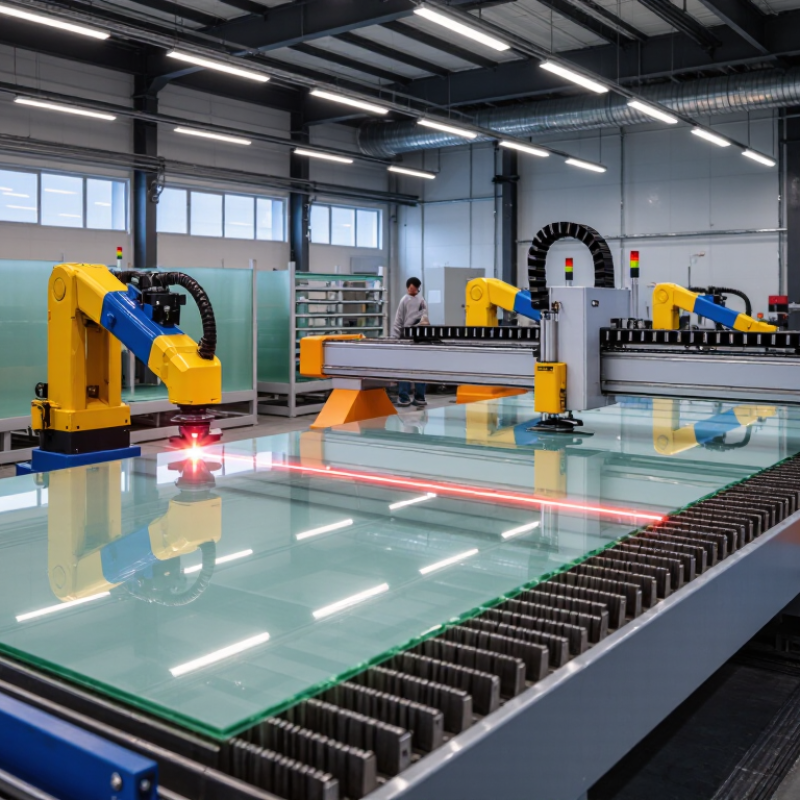
Automatic glass cutting machines use software, sensors, and motorized tools to cut flat glass with limited manual handling. They are common in architectural, furniture, automotive, and solar-glass production. For global buyers comparing the top 10 machines, understanding the workflow matters more than reading a feature list.
The process starts when an operator places a glass sheet on a powered loading table. Vacuum cups or air flotation help move the sheet without dragging it across the surface. Optical sensors check its position, size, and sometimes edge defects. The control system then reads a digital cutting plan and calculates the most efficient layout. Less waste means lower material costs.
A moving bridge carries a scoring wheel across the glass. It applies controlled pressure along programmed lines, creating clean, shallow scores rather than cutting through the entire sheet. A separate breaking system applies force along those scores, while waste pieces are removed. The result depends on glass thickness, temperature, wheel condition, and operator settings.
The process sounds flawless. It is not.
In real production, dust, uneven glass, or a poor calibration can cause chips and inaccurate edges. Buyers should request cutting samples, inspect tolerances, and verify electrical and safety requirements for their region. A reliable supplier should explain maintenance intervals, software support, training, and emergency-stop functions in clear technical language.
Top 10 Automatic Glass Cutting Machines for Global Buyers
Top 10 Automatic Glass Cutting Machines for Global Buyers
Global buyers need more than a fast cutting table. They need stable accuracy, safe handling, and measurable glass yield. The International Energy Agency reports that buildings consume about 30% of global final energy. This supports continued demand for energy-efficient glazing and low-emissivity glass. Automatic cutting machines must therefore process coated, laminated, and large-format sheets with minimal waste.
Industry reports from Grand View Research estimate steady growth in the global flat glass market through the next decade. However, market forecasts are not guarantees. A machine with advanced CNC control, optical positioning, automatic breakout, and barcode tracking can improve production flow. Its value depends on operator training, software compatibility, spare parts, and local service response. Buyers should request cutting-tolerance records from real production sites, not only brochures. Small differences matter when a 2-millimeter error ruins a large panel.
Tips: Check whether the system detects coating direction and glass defects. Confirm its maximum sheet size, loading method, power requirements, and safety interlocks. Ask for tested yield data using your own glass types. A cheaper machine may consume more glass through poor optimization. That hidden cost deserves attention. Also review the recovery plan for software failures and sensor replacement. A perfect specification sheet cannot replace practical trials.
How to Choose a Machine for Glass Types, Capacity, and Precision
Choosing an automatic glass cutting machine starts with the glass, not the machine’s advertised speed. Float, laminated, coated, Low-E, and patterned glass require different scoring pressure and handling methods. A machine for thin 3 mm sheets may struggle with 19 mm architectural glass. Grand View Research estimated the global flat glass market at over USD 100 billion in 2023, showing why capacity planning matters for growing workshops.
Check the maximum sheet size, table loading system, cutting speed, and nesting software. High-volume processors need reliable loading cycles and low breakage, not only impressive motion speed. For laminated glass, confirm compatibility with film cutting and separation processes. For coated glass, ask how the system protects the coating during positioning. Precision should be tested on your own samples. A stated tolerance of ±0.2 mm may change with glass thickness, temperature, and operator setup. The U.S. Department of Energy’s Glass Industry Roadmap also highlights energy efficiency and process control as important production priorities.
Tips: Request a cutting trial with your most difficult glass. Measure edge chips, dimensional error, and usable yield. Review service response times and spare-part availability before purchasing. A slower machine with stable accuracy can outperform a faster one. This is easy to underestimate. Also, capacity forecasts are often too optimistic, so leave room for seasonal orders, maintenance, and training.
Top 10 Automatic Glass Cutting Machines for Global Buyers
Common glass thickness ranges to consider when selecting an automatic cutting machine
Thickness ranges shown are common commercial processing ranges for the listed glass types. Buyers should also verify table size, cutting speed, loading capacity, edge accuracy, coating recognition, and compatibility with laminated or coated glass before making a final equipment choice.
 skip to Main Content
