skip to Main Content
A Plastic blind drain may look like a simple strip of molded material, but its performance depends on details buyers cannot judge from a product photo. Wall thickness, channel shape, filter fabric, and connection design can affect handling and drainage on site. Small details matter. A sample beside a project drawing often reveals more than a polished catalog image.
This guide presents seven practical buying tips for global buyers, from checking dimensions and material specifications to reviewing flow data, installation needs, packaging, and supplier quality records. Ask how test results were produced, and make sure they match the intended application. A drain suited to a landscaped walkway may not be suitable for a retaining wall or a heavily loaded area. It is easy to miss. Buyers should also confirm whether accessories and filter layers are included, rather than assuming the quoted product covers everything.
Experience helps, but it does not remove uncertainty. Product names can sound similar while designs differ, and a low unit price may not reflect freight, handling, or installation costs. Compare like with like, using written specifications and clear acceptance criteria. Still, no checklist can replace project-specific engineering review. That point is sometimes inconvenient, but important. Use these tips to ask better questions, reduce avoidable surprises, and choose a Plastic blind drain that fits the actual site conditions.
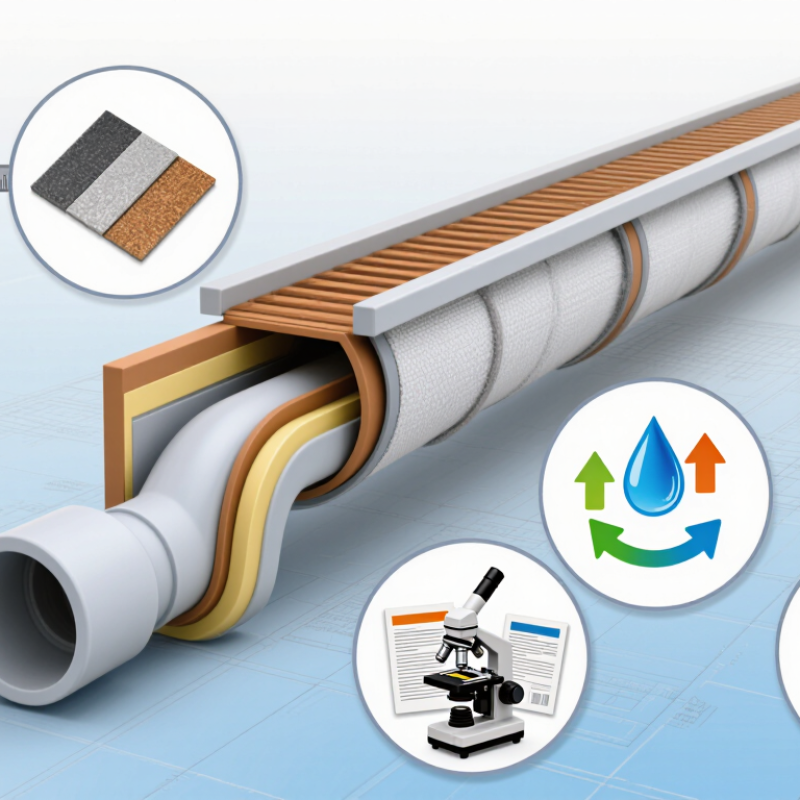
A plastic blind drain is a prefabricated drainage element that collects and carries water through a shaped plastic core. Many designs wrap the core in filter fabric, which helps limit soil particles entering its channels. The exact structure varies, so the term is not perfectly consistent across suppliers. Buyers should check a product cross-section, not rely on its name alone.
These drains are used behind retaining walls, beside foundations, beneath landscaped areas, and in some road or sports-field drainage systems. For example, a strip may sit vertically against a basement wall, directing seepage toward a collector pipe. In a planted area, it may lie beneath the soil to reduce waterlogging. Water needs an exit. Without a suitable outlet and a continuous route, the drain may collect water without removing it.
Project conditions matter. Fine soil can clog an unsuitable filter, while heavy loads may require a stronger core. Check the fabric, flow capacity, compressive strength, dimensions, and installation details against the site design. A common gap in specifications is the outlet connection; it deserves a clear drawing. Drainage layouts can look simple on paper, but soil conditions and installation tolerances are not always simple in the field.
A plastic blind drain is a buried perforated pipe that collects and conveys subsurface water. It is commonly used around foundations and retaining walls, beneath roads and sports fields, and in agricultural drainage systems. Filter aggregate or geotextile can help limit soil entry; the right arrangement depends on site conditions.
Bars show the calculated circular area of assumed internal bores, using A = πd² ÷ 4. This is a geometry comparison, not a flow-rate rating: actual internal diameter, perforations, slope, soil and filter design all affect drainage performance. Confirm product dimensions and site requirements before ordering.
Match the drain core to the water path, not just the drawing. A vertical retaining wall needs continuous flow behind the structure; a landscaped roof may need a shallow profile that fits its build-up. Check core thickness, rib direction, filter-fabric opening size, and outlet location against the soil and expected sediment. FHWA’s Geosynthetic Design and Construction Guidelines (NHI-07-092) treats drainage capacity, filtration, and compressive loading as connected design checks. There is no perfect catalog match.
Size the drain using peak inflow, drainage length, slope, and the load pressing on it. Ask suppliers for in-plane flow results under stated test conditions, not an isolated headline value. ASTM D4716 measures geosynthetic flow capacity under specified normal stress and hydraulic gradient; request conditions relevant to your project, such as tests at 20 and 100 kPa where suitable. Those figures are examples, not universal design limits. A result at 20 kPa cannot be compared directly with one at 100 kPa. Choose the polymer and fabric for temperature, chemical exposure, and installation stress, then confirm compatibility with the site soil. A common procurement mistake is choosing a thicker core without checking long-term compression. It can look reassuring. It may still restrict flow.
| Buying Tip | Project Requirement | Design or Size to Compare | What to Verify with the Supplier |
|---|---|---|---|
| 1. Match the drain format to the installation | Wall backfill, retaining structures, tunnels, foundations, or other confined drainage areas. | A narrow strip or panel drain suits linear installations; broader drainage sheets cover larger surfaces. Confirm whether the product is a geocomposite drain with a plastic core and filter fabric. | Core profile, installation orientation, drainage direction, and whether the design needs a separate collector pipe or outlet. |
| 2. Select width and thickness for the available space | Trench or cavity dimensions, wall geometry, and clearance around penetrations or structural details. | Compare drain width and core thickness against the drawings. Available dimensions vary by product; do not assume that nominal thickness equals the installed drainage gap under load. | Dimensional tolerances, roll or panel lengths, cutting method, and the product’s thickness under the specified compressive load. |
| 3. Check flow capacity under project conditions | Expected water inflow, drainage path length, slope, and the pressure from soil or adjacent construction. | Compare in-plane transmissivity or flow rate, not just the visual size of the core. Flow performance depends on hydraulic gradient, normal pressure, and test conditions. | Test method, applied pressure, hydraulic gradient, specimen orientation, and whether reported results are short-term or include long-term reduction factors. |
| 4. Choose a polymer suited to exposure and temperature | Buried or exposed use, soil chemistry, installation temperature, and expected service environment. | Plastic cores are commonly made from polymers such as HDPE or polypropylene. The right choice depends on the product design and project exposure; material names alone do not establish durability. | Polymer identification, recycled-content disclosure if relevant, chemical-resistance data for the expected exposure, and declared temperature limits. |
| 5. Match the filter fabric to the soil | Soil particle-size distribution, fines content, groundwater conditions, and risk of soil migration into the drainage core. | Compare geotextile apparent opening size, permittivity, and robustness with the project’s soil-retention and water-flow requirements. A finer fabric is not automatically better for every soil. | Relevant test reports, fabric type and mass per unit area, seam or wrap details, and compatibility with the project soil. |
| 6. Confirm compressive performance and protection needs | Burial depth, backfill type, compaction method, and construction traffic or handling loads. | Compare compressive behavior at a stated load and consider whether a protection or separation layer is needed. A peak compressive-strength figure alone may not describe flow retention over time. | Test method, deformation at the stated load, flow capacity under load, and installation guidance for backfilling and compaction. |
| 7. Plan outlets, joints, and compliance before ordering | Drain termination, connection to a collector, site layout, local regulations, and delivery constraints. | Check compatible connectors, overlap or joint details, outlet spacing, roll dimensions, and packaging. A drainage layer needs a clear route for water to discharge. | Project-specific drawings, applicable local specifications, current product test reports, installation instructions, and a sample or mock-up where details are critical. |
Note: Dimensions and performance requirements are project-dependent. Confirm design values, test conditions, local code requirements, and installation details with the project engineer and supplier before procurement.
For a plastic blind drain, check the whole drainage path, not just the pipe’s advertised flow rate. The FHWA Geosynthetic Design and Construction Guidelines (FHWA-HI-95-038) treats filtration, drainage, and survivability as distinct design functions. Ask for test results showing flow capacity under the expected soil pressure, plus filtration data for the surrounding geotextile. ASTM D4716 measures in-plane flow, while ASTM D4491 measures geotextile water permittivity. A clean-water result alone may not reflect performance after soil fines and compression are involved. This detail is easy to miss.
Durability checks should match the installation: handling, backfill pressure, soil chemistry, and temperature. Request compressive or crush-resistance data, tensile properties, and evidence that the core retains its shape under load. ASTM D4751 provides a method for measuring geotextile apparent opening size, helping assess whether soil particles can pass through the filter. Compare certificates with the actual product specification, including dimensions and test conditions. A neat certificate is not proof that every production batch was tested. Ask for batch traceability and independent laboratory reports where available. If two products use different test methods, their headline figures may not be comparable. I would not accept a single “high-flow” number as enough evidence.
When comparing plastic blind drain suppliers, request test data for flow capacity under the expected soil pressure, not just an unloaded laboratory result. Check core thickness, roll width, filter fabric, joint details, and resistance to clogging. A drainage product can look sturdy yet compress under backfill. Ask for recent quality-control records, batch traceability, and independent test reports; then compare a sample with the project specification. One useful benchmark: Grand View Research estimated the global geosynthetics market at about US$12.7 billion in 2023, with projected growth through 2030. A growing market does not guarantee consistent product quality.
Price quotes need the same basis. Compare cost per usable metre, including fabric, connectors, packaging, inland transport, and delivery terms. Confirm minimum order quantity, production lead time, payment schedule, and whether custom widths affect tooling or setup fees. Get the quote’s validity period in writing. Small detail. A low unit price may become expensive if rolls arrive damaged or dimensions vary. Ask how the supplier handles rejected batches and replacement freight.
Order requirements should match the site, not a generic catalog description. Share drainage layout, expected loads, soil type, installation method, and storage conditions. Request written confirmation of the selected product’s limits. PlasticsEurope’s Plastics—The Fast Facts 2024 reports global plastics production of 413.8 million tonnes in 2023, but broad supply figures cannot predict a specific supplier’s stock or resin pricing. Verify current availability directly. I would still leave room for uncertainty: test results and quotations can change between production batches.
A plastic blind drain may look simple, but shipping details can change the real cost. Compare quotes by total landed cost, not unit price alone. Ask for carton dimensions, gross weight, pallet layout, and the number of units per shipment. These details affect container use and handling fees. Request photos of packed goods, too. A small fitting can shift or crack if cartons are poorly secured. It happens.
Compliance needs careful checking before an order is placed. Ask the supplier for material data, product drawings, and test reports relevant to the drain’s intended use. Confirm that document names and specifications match the exact model being quoted. Requirements vary by destination and project, so have the importer or project engineer review them. A certificate with a similar product name may not be enough.
After-sales support is easier to judge when expectations are written down. Check who handles damaged shipments, missing pieces, or installation questions, and ask how quickly they usually respond. Agree on a process for submitting photos and batch details. Keep one sample for comparison when the order arrives. Small production differences are worth recording, even when they seem harmless. I would also ask whether spare parts can ship separately; it may cost more, but delays can cost more.
