Top KMnO4 Activated Alumina Suppliers for Global Buyers
Choosing a reliable source for KMnO4 Activated Alumina takes more than comparing prices. Global buyers need to assess product consistency, technical support, packaging, and delivery capability. This material is used in gas-treatment applications, but performance depends on the target contaminant, operating conditions, and system design. A supplier’s headline capacity alone cannot confirm that a product suits a specific installation.
Look for clear technical data, including potassium permanganate content, alumina form, particle size, moisture limits, and recommended handling conditions. Ask for a current safety data sheet, product specification, and batch-level documentation. Details matter. A small difference in particle size can affect pressure drop and bed loading, while damaged bags can complicate storage and dosing. Where practical, request a sample and evaluate it against your process requirements before placing a large order.
For international sourcing, compare lead times, export packaging, order minimums, and the supplier’s process for addressing quality concerns. Check whether technical staff can explain test methods and limitations without promising identical results in every system. No supplier is best for every buyer. A polished product page is useful, but it is not a substitute for evidence. Supplier claims also deserve review; specifications may not answer every application question. This guide helps buyers compare potential KMnO4 Activated Alumina suppliers with practical criteria, while recognizing that final selection should reflect verified documents, application needs, and a realistic assessment of risk.
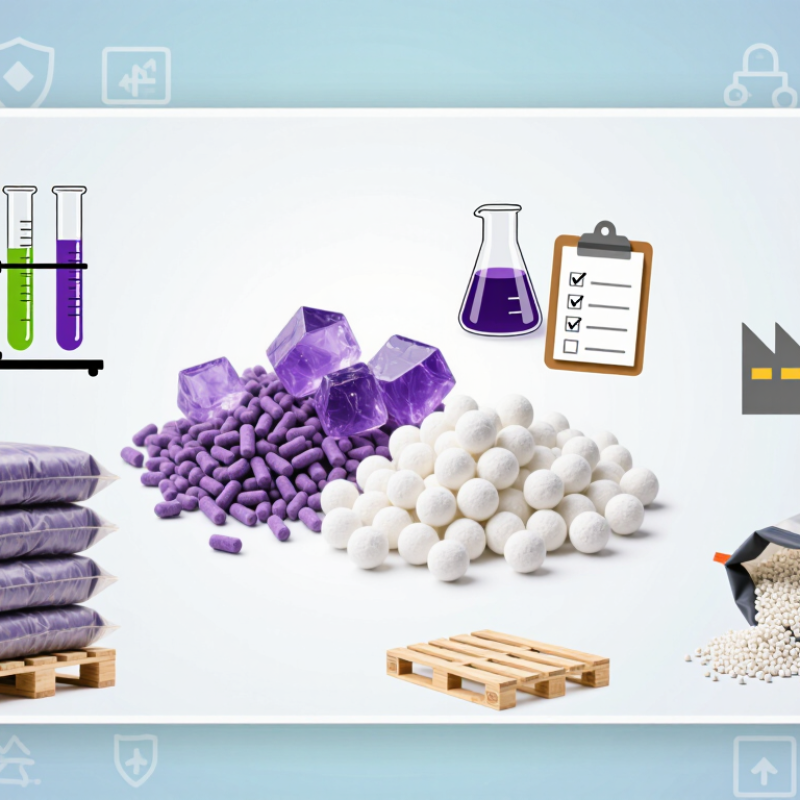
Understanding KMnO₄-Activated Alumina and Its Applications
KMnO₄-activated alumina is porous alumina carrying potassium permanganate, an oxidizing agent. Its large internal surface gives contaminated air many contact points as it passes through a packed bed. The media is commonly used to reduce hydrogen sulfide and certain other odor-causing or reactive gases. In a maintenance room, for example, a properly sized filter may help control a sharp sulfur-like smell near a drain or process line. Not magic. Performance depends on the target gas and the media formulation.
As contaminants react with the permanganate, the active material is gradually consumed, and the media may change from purple toward brown. Color can offer a useful visual clue, but it does not reliably measure remaining capacity. Real-world results also depend on airflow, humidity, temperature, contaminant concentration, and bed depth. Poor sealing or uneven packing can let air bypass the media. That detail is easy to miss. Buyers should match test data to their actual gas mixture and operating conditions, then confirm replacement intervals through monitoring. Some applications need additional treatment stages, and a supplier’s broad removal claims deserve careful review. A small pilot test can reveal issues that a specification sheet cannot.
Mapping the Global Supplier Landscape and Product Offerings
Top KMnO4 Activated Alumina Suppliers for Global Buyers
Mapping the Global Supplier Landscape and Product Offerings
Global suppliers of potassium-permanganate-impregnated activated alumina serve water and air-treatment markets. Their catalogs commonly list granular media in different sizes, bulk packaging, and application-specific specifications. The USGS Mineral Commodity Summaries 2025 estimates global manganese mine production at about 20 million metric tons in 2024. This is upstream context, not a measure of treated-media availability. Supplier maps remain imperfect; public capacity and export data are limited.
Compare suppliers by impregnation level, particle size, bulk density, moisture, and stated operating conditions. Request a current technical data sheet, safety data sheet, batch traceability, and independent performance results. Ask how the media performs under your actual flow, contaminant load, and water chemistry. WHO and UNICEF’s 2023 Joint Monitoring Programme estimated that 2.2 billion people lacked safely managed drinking water in 2022, showing the scale of treatment needs—not demand for any single filter medium. Product claims still need site-specific verification.
Tips: Ask for representative samples and a clear replacement criterion. Check shipping lead times, packaging integrity, and support for pilot testing. Small details matter. A supplier’s published capacity may not match your operating conditions.
Evaluating Supplier Quality, Capacity, and Certifications
Top KMnO4 Activated Alumina Suppliers for Global Buyers
Evaluating Supplier Quality, Capacity, and Certifications
A supplier’s datasheet is only a starting point. For potassium permanganate-treated alumina, buyers should review media size, permanganate loading, crush strength, and batch-to-batch variation. Request a recent certificate of analysis and test results from an independent laboratory. Then compare them with a sample tested against your actual water chemistry. Small details matter.
Capacity claims need context. Iron, manganese, pH, flow rate, and competing substances can all affect service life. The US EPA lists 0.05 mg/L as the secondary drinking-water standard for manganese; it is an aesthetic benchmark, not a promise of treatment performance. Ask suppliers to state the test conditions behind their capacity figures, along with recommended backwash rates and replacement criteria. Bench tests help, but full-scale performance may differ. That part is easy to underestimate.
Check whether the producer can supply consistent volumes, retain samples, and trace each lot to its production records. ISO 9001 certification can indicate a documented quality system, but it does not certify media performance. For potable-water applications, confirm whether NSF/ANSI/CAN 61 certification applies to the exact product and intended use. Review certificate scope and expiry dates directly. A polished certificate is reassuring, though it cannot replace a site trial.
Comparing Pricing, Shipping, and Regional Sourcing Options
Top KMnO4 Activated Alumina Suppliers for Global Buyers
A meaningful quote compares more than price per kilogram. Ask suppliers to specify potassium permanganate loading, alumina grade, particle size, moisture limits, packaging, minimum order, and Incoterms. Otherwise, two quotes may describe different products. Request a recent certificate of analysis and a sample specification before comparing landed costs. Small details matter.
Regional sourcing changes the trade-off. Asian production hubs may offer broader capacity, while regional distributors in Europe or North America can reduce inland transit and simplify replenishment. Neither route is automatically cheaper. UNCTAD’s Review of Maritime Transport 2024 notes that shipping carries over 80% of world trade by volume, making port access and freight conditions significant purchasing factors. The World Bank’s Logistics Performance Index 2023 reported an average 44-day journey from an exporter’s warehouse to an importer’s warehouse. Plan inventory accordingly.
Compare quotes using the same destination, shipment size, packaging, and delivery terms. Ask for separate freight, insurance, and handling charges, plus an estimated dispatch window. A lower factory price can lose its advantage after port delays or costly last-mile delivery. Not always. The comparison is imperfect, too: transit estimates can shift, and smaller buyers may receive different freight rates than quoted market averages. Recheck lead times before placing a repeat order.
Selecting and Verifying a Reliable Supplier for Long-Term Supply
A reliable KMnO4 activated alumina supplier should provide more than a competitive quotation. Ask for current batch certificates showing key specifications, such as potassium permanganate content, particle size, moisture, and packaging details. Paperwork matters. Check that batch numbers on certificates match the labels on sample containers, and ask how production changes are documented.
Request a representative sample before committing to a long-term contract. Compare its appearance and physical condition with the agreed specification, then consider independent testing for critical parameters. A neat sample is encouraging, but it does not prove every shipment will be consistent. Ask how the supplier handles out-of-spec batches, retained samples, and customer complaints. The answer should be specific, not simply reassuring.
Long-term supply also depends on practical details. Confirm production capacity, typical lead times, storage guidance, and packaging that protects the media from moisture and damage during transit. Ask whether the supplier will notify you before changing raw materials or manufacturing processes. Small details count. Even careful checks cannot predict every delay, and buyers sometimes overlook communication quality when comparing prices. A clear contact process and realistic delivery updates can matter just as much as a specification sheet.
 skip to Main Content
