How to Choose the Best Truck Ratchet Straps?
Choosing the right Truck Ratchet Straps starts with the load, not the color of the webbing or the price tag. A narrow strap may suit a light garden tractor, while a heavier machine needs compatible straps, anchor points, and a securement plan. Check the working load limit, strap width, fitting type, and webbing condition. The working load limit matters more than a dramatic break-strength number. Look for readable labels. Frayed edges, bent ratchets, and cracked hooks are reasons to stop and inspect.
A practical reminder for buyers: “Match every strap to the load, the anchor, and the job.” This is original editorial guidance, not a verified quotation from a named industry expert; attributing it to someone without a reliable source would be misleading. In the sections ahead, we’ll compare strap capacities, materials, hooks, and ratchet mechanisms, then consider how to inspect and store them. Small details count. A hook that barely fits an anchor can shift under tension, and wet, gritty webbing may conceal wear. Real loads are rarely perfect rectangles, either. Measure carefully, follow the manufacturer’s instructions, and leave room to reassess your setup. No strap choice replaces sound judgment.
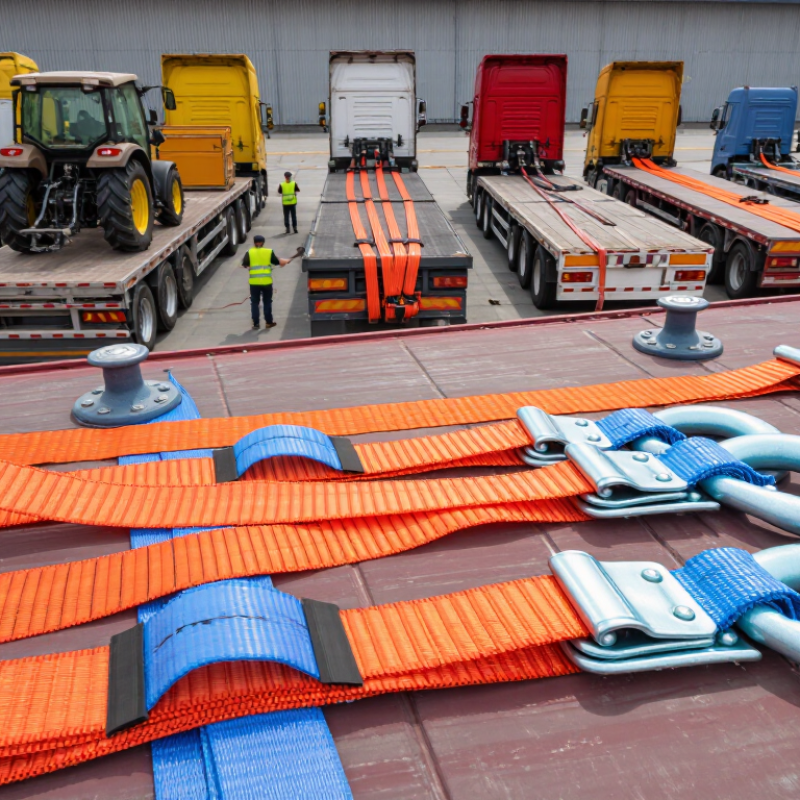
What Are Truck Ratchet Straps and How Do They Work?
Truck ratchet straps are webbing tie-downs used to restrain cargo during transport. A typical assembly has a ratchet handle, spool, polyester webbing, and end fittings such as hooks. Thread the loose end through the spool, remove slack, then pump the handle. The spool winds the webbing tighter. The ratchet pawl locks against reverse movement. It holds tension. To release it, open the handle fully and disengage the mechanism as designed. Keep fingers clear; a loaded strap can recoil.
Capacity matters more than appearance. Check the tag for the working load limit (WLL), not just breaking strength, and inspect stitching, webbing, and fittings for cuts, fraying, corrosion, or distortion.
The FMCSA’s Cargo Securement Rules, under 49 CFR Part 393, require the combined WLL of tiedowns to be at least half the weight of the secured cargo in covered cases. That is a baseline, not a reason to guess.
2,000 lb
load
→
1,000 lb
aggregate WLL
For example, a 2,000-pound load calls for at least 1,000 pounds of aggregate WLL under that rule.
The right setup also depends on load shape, tie-down angle, and anchor points. A strap that feels tight may still be poorly placed. I would check tension again after the load settles; that small step is easy to forget.
How Do You Calculate the Required Load Capacity?
To calculate the required load capacity for truck ratchet straps, start with the cargo’s actual weight, not its estimated size. A 1,200-pound machine needs securement that can resist movement during braking, cornering, and road vibration. Check the working load limit (WLL) printed on each strap; breaking strength is not the usable rating. Keep the distinction clear.
The required capacity depends on how the straps are arranged. With direct tie-downs, consider the WLL of the straps resisting movement in each direction. With indirect, or friction-based, tie-downs, the cargo’s weight, contact surfaces, strap tension, and tie-down angle all affect performance. A steep angle can reduce useful force. Follow the applicable securement rules and strap manufacturer’s instructions, since calculation methods can differ.
For a practical check, list the cargo weight, strap WLLs, attachment points, and tie-down layout before loading. Then confirm that the combined effective capacity meets the required level, rather than simply adding every strap rating together.
Check the labels and hardware closely. A frayed edge, bent ratchet, or unreadable rating makes capacity uncertain. Allow for uneven tension, too. It happens. I would rather add a properly rated strap than rely on a neat-looking calculation that ignores a shifting load.
Which Strap Length, Width, and Material Fit Your Cargo?
Choosing strap length starts with the cargo, not the truck bed alone. Measure the load’s width, height, and path around its anchor points. A strap should reach comfortably without barely catching the ratchet. Too much loose webbing can flap or snag, so secure the tail after tightening. Leave room to operate the handle. A tight fit matters.
Width affects handling and load distribution, but it does not tell you the strap’s strength by itself. Check the working load limit printed on the strap label, and compare it with the cargo and tie-down plan. Wider webbing may spread pressure across a broad, sturdy surface. It can still damage a sharp edge without corner protection. That detail is easy to miss.
Material also changes how a strap behaves. Polyester webbing has relatively low stretch and resists moisture well, making it a common choice for truck cargo. Nylon stretches more under load, which may allow movement during transport. Inspect the webbing for cuts, fraying, melted spots, or damaged stitching before use. Replace questionable straps; guessing is not a reliable inspection method. Match strap length, width, and material to the cargo shape, anchor points, and labeled capacity, then recheck tension after loading.
How to Choose the Best Truck Ratchet Straps? — Which Strap Length, Width, and Material Fit Your Cargo? | Cargo or Use Case | Typical Strap Width | Useful Strap Length | Common Webbing Material | Key Selection Notes |
| Motorcycle or compact equipment | 1 in (25 mm) | 6–10 ft (1.8–3 m) | Polyester | Choose straps with suitable end fittings and protect webbing from sharp edges. Secure the load at multiple points without compressing delicate parts. |
| Furniture, appliances, or boxed cargo | 1–2 in (25–50 mm) | 10–16 ft (3–4.9 m) | Polyester | Measure the path around the cargo and anchor points. Use corner protectors where straps contact edges, and avoid overtightening fragile items. |
| ATV, mower, or medium machinery | 1.5–2 in (38–50 mm) | 12–20 ft (3.7–6.1 m) | Polyester | Match the strap’s working load limit to the cargo and tie-down arrangement. Check that hooks or other fittings are compatible with the vehicle anchors. |
| Palletized building materials | 2 in (50 mm) | 16–27 ft (4.9–8.2 m) | Polyester | Use edge protection and secure the load against forward, backward, and sideways movement. Strap length depends on pallet size and anchor-point spacing. |
| Heavy equipment or large industrial cargo | 3–4 in (75–100 mm) | 20–30 ft (6.1–9.1 m), as required | Polyester | Follow the cargo securement plan and applicable regulations. Select rated assemblies based on their marked working load limit, not appearance alone. |
| Loads exposed to frequent rain or outdoor conditions | Choose width according to load and rating | Choose length after measuring the tie-down route | Polyester is commonly used because it absorbs little water and has low stretch | Inspect regularly for abrasion, cuts, damaged stitching, chemical exposure, or heat damage. Keep straps clean and dry them before storage. |
How Should You Choose End Fittings and Safety Ratings?
End fittings should match the truck’s anchor points, not just the strap width. Flat hooks sit well on wide, accessible rails, while wire hooks can fit smaller rings. A twisted hook may not lie flat. Check that each fitting closes or seats securely, with no sharp edges that could cut webbing. Try the connection before loading; a hook that looks right can still shift under tension.
Read the strap’s working load limit, or WLL, rather than relying on break strength alone. The WLL indicates the rated load for normal securement, while break strength describes failure under test conditions. Do not treat them as interchangeable. Add the load ratings of the straps only as permitted by the securement method and applicable requirements. The cargo’s weight, shape, and movement all matter. Heavy? Use a larger margin.
Look for clear, permanent rating labels on both the strap and its fittings. If a label is missing, faded, or unreadable, the true capacity is uncertain. Inspect stitching, webbing, and hook bends before every trip; cuts, melted spots, corrosion, or deformation call for replacement. I have found that small hook wear is easy to overlook in poor light. A quick check helps, but it does not make damaged gear safe.
Choosing end fittings and safety ratings: Under U.S. federal cargo-securement rules, the aggregate working load limit (WLL) of tie-downs securing an article must be at least 50% of that article’s weight. Choose fittings suited to the anchor point and use the marked WLL for the complete tie-down assembly; its WLL is limited by its weakest component. The chart shows the regulatory minimum, not a recommended maximum or a rating for any particular strap.
How Do You Inspect and Use Ratchet Straps Safely?
Inspect every strap before loading. Check the webbing for cuts, melted fibers, fraying, chemical stains, or pulled stitching. Examine the ratchet, handle, and hooks for cracks, bending, rust, or sharp burrs. A damaged strap can fail under tension. Retire it; do not patch it with tape. Check the label for working load limit, and never confuse that rating with breaking strength. The Federal Motor Carrier Safety Administration’s cargo-securement rules require tiedowns to meet specified aggregate strength requirements, including restraint against 0.8 g forward acceleration and 0.5 g lateral acceleration. Your setup still needs to suit the cargo.
Place straps over stable contact points, not sharp edges. Use edge protection where webbing touches corners. Keep the ratchet aligned, then pull the handle through smooth strokes until snug; excessive force can damage cargo or hardware. Close and lock the handle before travel. After tightening, check that hooks cannot slip free and that loose webbing is secured. A small twist in a strap may seem harmless, but it can concentrate wear.
The FMCSA’s 49 CFR 392.9 requires drivers to inspect cargo securement within the first 50 miles and recheck it during the trip at specified intervals, including after a change in duty status. Stop somewhere safe to inspect. Look for slack, shifted cargo, or straps rubbing against metal. Retighten when needed. I still find it easy to overlook the underside of a load; a flashlight helps.
 skip to Main Content
