How to Choose the Best Pipe Swaging Machine?
Choosing the right Pipe Swaging Machine starts with the tube, not the brochure. Define your material, outside diameter, wall thickness, and required finished shape. Then check the machine’s working range against real production parts. A machine that handles one sample beautifully may struggle with a full shift of mixed sizes. Small details matter.
For a practical buying perspective, this guide uses an illustrative expert voice: pipe-forming specialist Daniel Mercer. His guiding principle is: “Match the machine to your hardest repeatable job, not your easiest demonstration.” This is an original editorial line, not a verified quotation. The point is worth considering. Ask suppliers for trial results using your material and tooling, and inspect the swaged ends for consistency, surface marks, and dimensional accuracy. Listen to the machine under load. Watch how quickly operators can change dies and secure each pipe.
Capacity is only part of the decision. Compare swaging method, clamping arrangement, control options, maintenance access, and operator training. Ask what routine service involves. Check whether tooling is available for your profiles and future product changes. A low purchase price can hide costly setup time. It happens.
A careful choice balances output, repeatability, safety features, and after-sales support. Still, no specification sheet can answer every question. Your parts, operators, and production rhythm will reveal the gaps. Use this guide to build a shortlist, challenge broad claims, and decide which machine fits your actual workshop—not an idealized one.
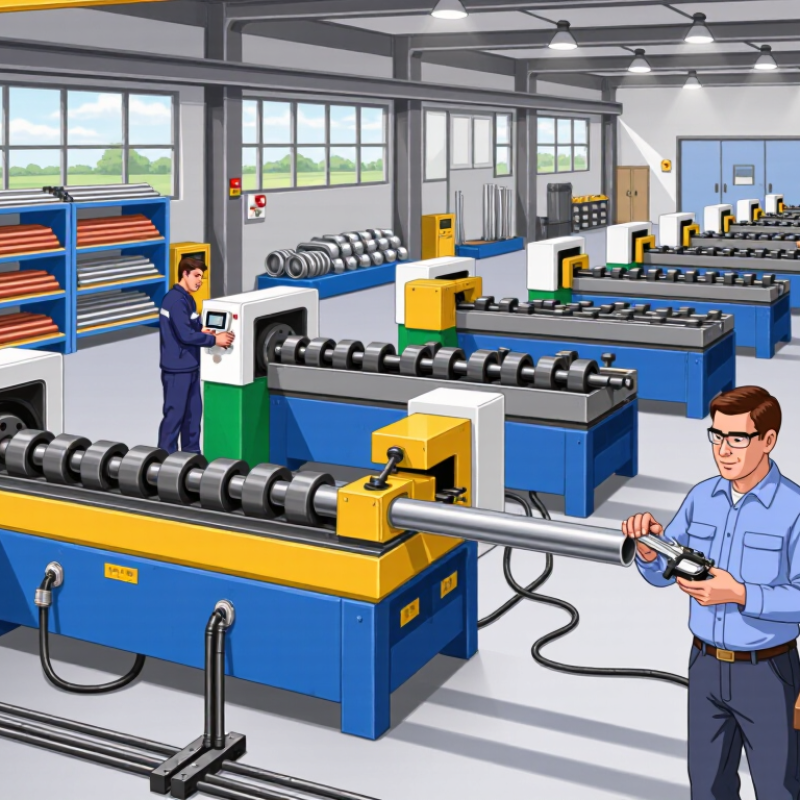
What a Pipe Swaging Machine Does and How It Works
A pipe swaging machine reshapes a pipe or tube end by pressing it with dies. It can reduce the diameter to fit inside another section, or form an expanded end for a connection. Unlike cutting, swaging changes the material’s shape rather than removing it. The finished end may support a tighter joint, but the result depends on the pipe material, wall thickness, and required dimensions.
In a typical setup, the operator selects dies matched to the pipe and desired profile. The pipe is positioned against a stop, then the dies close around its end. Some machines use a press action; rotary models apply rapid, repeated blows as the workpiece moves through the tooling. A mandrel may support the inside when the forming process requires it. Keep it centered. Misalignment can create an uneven rim or a tapered section that does not fit properly.
Before production, check the machine’s capacity and the tooling range against the pipe’s outside diameter and wall thickness. A short test piece can reveal springback, surface marks, or cracking before valuable stock is used. Measure the formed end at several points, not just across one axis. Material behavior can be a little stubborn, and settings that work on one tube may not transfer neatly to another. Record the setup and inspect the first parts as the tooling warms and conditions settle.
How to Choose the Best Pipe Swaging Machine: What It Does and How It Works
A pipe swaging machine uses dies that repeatedly strike a tube as it rotates or feeds through the tooling, reducing the diameter of its end. The chart shows an illustrative set of outside-diameter measurements along one swaged tube end—not a machine specification. Actual results depend on the tube material, wall thickness, tooling, and process settings.
Which Pipe Materials, Diameters, and Wall Thicknesses Must It Handle?
A pipe swaging machine should match the materials you actually process, not just the materials listed on a sales sheet. Copper and aluminum often form more readily than stainless steel, while harder alloys may need greater forming force and carefully matched dies. Ask whether the machine can swage each alloy without splitting, wrinkling, or leaving an uneven transition. Material temper matters, too. A soft tube and a hardened tube of identical size can behave very differently.
Check the full diameter range, including the smallest and largest pipes you run. A machine may accept a broad nominal range but still need different tooling for each size. Confirm how quickly dies can be changed and whether the setup holds the pipe straight. Even slight misalignment can create an off-center reduction. Test real samples. A brochure cannot show every shop-floor variation.
Wall thickness deserves equal attention. Thin-wall pipe can buckle under excessive pressure; thick-wall pipe may need more capacity than the machine provides. Share actual outside diameters, wall thicknesses, materials, and target end dimensions with the supplier, then request a trial on representative stock. Measure the finished end for roundness and fit. I would check twice. One detail is easy to miss: unusual seams or material variation can affect results, so leave room for adjustment rather than choosing a machine at its stated limit.
How to Compare Swaging Methods and Machine Types
Pipe swaging machines differ by how they apply force. Rotary swaging uses rotating dies to reduce tube diameter around its circumference. It suits repeatable reductions and shaped ends, but tooling and setup affect results. Press or radial swaging applies force in controlled strokes and may suit localized forming or lower production volumes. Compare both methods using your actual alloy, wall thickness, starting diameter, and required finish—not a catalog example.
Machine type matters too. Mechanical systems can offer fast cycles, while hydraulic models provide adjustable force and controlled movement. CNC controls help repeat complex profiles, though they add programming and maintenance needs. The U.S. Department of Energy’s Advanced Manufacturing Office reports that motor-driven systems account for about 54% of U.S. manufacturing electricity use. That figure is not swager-specific, but it makes drive efficiency and idle power worth checking. A polished specification sheet can still hide a poor fit.
Tips: Ask suppliers to form sample tubes from your material. Measure final diameter, wall thinning, ovality, and cycle time. Check changeover time and noise at the operator’s station. I would not choose on rated force alone; real parts can surprise you.
How to Assess Cost, Maintenance, and Supplier Support
A pipe swaging machine’s price is only one part of its cost. Compare tooling, installation, training, energy use, and expected output before deciding. Ask for a written quotation that lists included dies and any optional equipment. Then estimate cost per finished fitting, using your actual shift length and production mix. Small costs add up. A spreadsheet helps, but it can still miss the price of an unexpected delay.
Maintenance affects that estimate. Check how often the machine needs lubrication, inspection, and die replacement. Ask how long common service tasks take, and whether operators can perform them safely after training. A supplier should explain spare-part availability, warranty limits, and typical response times. Request a sample maintenance schedule and confirm which parts are stocked locally. Support promises sound reassuring, but vague answers deserve follow-up.
Tips: Ask the supplier to demonstrate a representative tube size and material. Note setup time, noise, and how easily adjustments can be repeated. Request references from users with similar workloads, not just the largest production lines. Compare service terms in writing. If projected savings depend on perfect uptime, revise the estimate; real shops rarely run perfectly.
 skip to Main Content
