 skip to Main Content

How to Choose the Best Digital Smart Water Meter
Choosing the right Digital Smart Water Meter is no longer a simple hardware decision. It affects billing accuracy, leak response, maintenance costs, and customer trust. The United Nations World Water Development Report 2024 states that 2.2 billion people lacked safely managed drinking water in 2022. This pressure makes every measured cubic metre more important.
The U.S. Environmental Protection Agency estimates that household leaks waste nearly 1 trillion gallons of water annually in the United States. A reliable meter can expose unusual night-time consumption, continuous flow, or sudden pressure changes. However, connectivity alone does not guarantee useful data. Buyers should examine measurement accuracy, battery life, communication protocols, cybersecurity controls, installation conditions, and platform compatibility. The American Water Works Association’s M36 manual also emphasizes structured water audits and loss-control practices. A meter should support these processes, not merely display attractive charts.
Real installations are less perfect than product brochures suggest. Concrete walls can weaken wireless signals. Sediment can affect components. Technicians may also face limited access to power or replacement parts. These details matter. The best Digital Smart Water Meter should match the pipe diameter, water quality, climate, and operating skills of the site. Buyers should request independent test results, warranty terms, calibration procedures, and references from comparable projects. A low purchase price may become expensive when data gaps require manual checks. No meter solves every loss problem. Still, a carefully selected system can turn invisible waste into visible evidence, helping utilities and facility managers make faster, more defensible decisions.
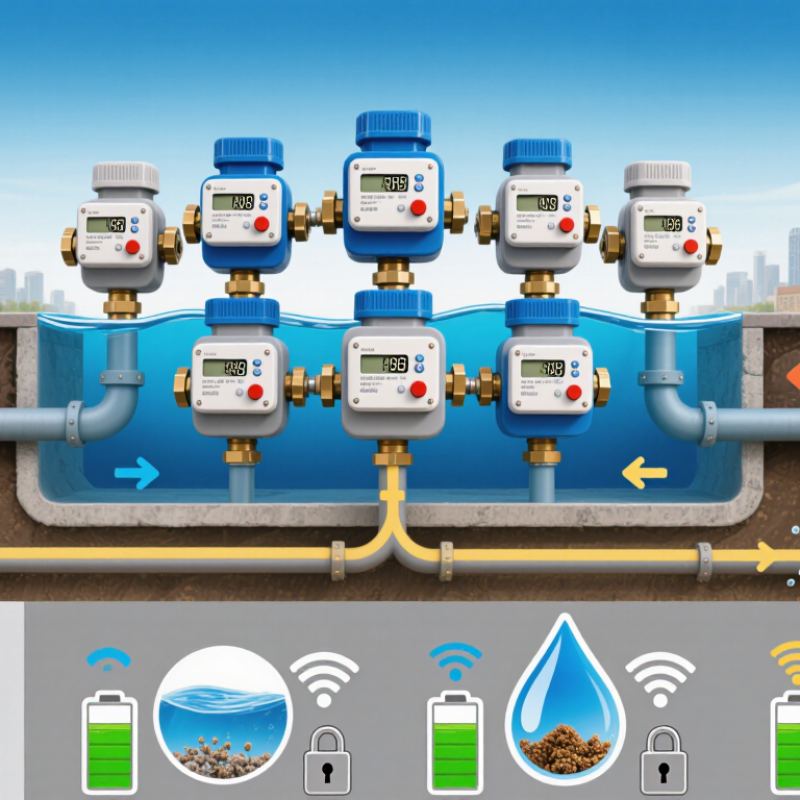
What Is a Digital Smart Water Meter and How Does It Work?
A digital smart water meter measures water flow and converts it into electronic data. Unlike a traditional meter, it can record usage at regular intervals. Many models use ultrasonic sensors, while others use mechanical or electromagnetic methods. Ultrasonic meters calculate flow by comparing sound travel times through the pipe. No moving parts are required.
Inside the meter, a processor converts flow readings into litres or cubic metres. A screen shows current or accumulated consumption. A wireless module may send readings to a gateway or monitoring platform. Some systems report hourly usage, low battery levels, reverse flow, or possible leaks. In practical installations, a sudden overnight reading can reveal a dripping toilet or damaged pipe before the bill becomes unusually high.
Choosing the best digital smart water meter requires more than checking its display. Confirm the pipe size, flow range, pressure rating, battery life, and protection against moisture. Calibration records and compliance with local measurement requirements also matter. Data encryption and controlled access should be considered for connected systems. No meter is perfect. Poor installation, trapped air, or sediment can reduce accuracy. I have found that clear installation instructions are often as valuable as advanced features. A simple meter that communicates reliably may serve better than a complicated model with unused functions.
How to Choose the Best Digital Smart Water Meter - What Is a Digital Smart Water Meter and How Does It Work?
| Selection Dimension | Typical Data or Options | What to Look For | How It Works or Why It Matters |
|---|---|---|---|
| Measurement Technology | Ultrasonic, electromagnetic, or mechanical positive-displacement/turbine measurement | Choose ultrasonic for low maintenance and leak monitoring; choose electromagnetic for suitable conductive water; use mechanical designs where simple local measurement is the priority. | Ultrasonic meters calculate flow from the travel-time difference of sound waves. Electromagnetic meters use Faraday’s law. Mechanical meters measure the movement of an internal rotor, piston, or disc. |
| Measurement Accuracy | Certified models are commonly tested against ISO 4064 or OIML R49 requirements; accuracy class and operating range vary by model. | Verify the certified accuracy class, minimum flow rate, maximum flow rate, and installation conditions rather than relying only on a headline accuracy percentage. | Accuracy is affected by flow velocity, water quality, pipe configuration, air in the line, temperature, and whether the meter is installed within its approved operating range. |
| Nominal Pipe Size | Residential and small commercial installations commonly use DN15 to DN50; larger buildings and networks may require DN65 and above. | Match the meter’s nominal diameter and connection type to the existing pipework and expected peak demand. | An incorrectly sized meter can create unnecessary pressure loss, reduce low-flow sensitivity, or operate outside the intended measurement range. |
| Flow-Rate Range | The useful range is specified by a minimum flow rate, continuous flow rate, and overload or maximum flow rate. | Select a meter that can detect the smallest expected leakage while safely handling the highest normal demand. | The sensor converts water movement into volume data. A wider usable range helps identify both continuous low flows and short periods of high consumption. |
| Display and Units | Common units include cubic metres (m³), litres (L), and, in some markets, gallons. Displays may be LCD or electronic register based. | Choose a readable display with clear total-consumption, flow-rate, alarm, and battery-status information. | The register stores accumulated volume and may also show instantaneous flow, reverse flow, error codes, and configuration status. |
| Communication Method | Optical or wired reading, short-range radio, wireless mesh, cellular IoT, or low-power wide-area communication | Consider reading distance, network coverage, data frequency, cybersecurity requirements, and the cost of communication infrastructure. | The meter transmits stored readings and event information to a handheld reader, gateway, building system, or remote data platform. |
| Data-Logging Interval | Typical records may be stored at intervals such as 15 minutes, 30 minutes, hourly, or daily, depending on configuration. | Use shorter intervals for leak analysis and demand management; use longer intervals where storage and transmission costs must be minimized. | Time-stamped consumption records create a usage profile that can reveal abnormal flow patterns, night-time consumption, and sudden changes in demand. |
| Leak and Tamper Detection | Possible events include continuous flow, burst flow, reverse flow, empty pipe, abnormal consumption, magnetic interference, and unauthorized removal. | Confirm which alarms are supported, how thresholds are configured, and whether alerts can be transmitted remotely. | The meter compares measured flow, direction, duration, and operating conditions with programmed rules to identify possible leaks or interference. |
| Power Supply and Battery Life | Battery-powered meters commonly use sealed lithium batteries; service life is often designed for several years and depends on transmission frequency and temperature. | Check the stated battery life under the intended reading interval, communication method, and environmental conditions. | Low-power electronics and scheduled communication reduce energy consumption. A sealed battery may require replacing the complete register or meter at the end of its service life. |
| Ingress Protection | Meters installed in pits or damp locations are commonly specified with high enclosure protection, such as IP67 or IP68, when certified by the manufacturer. | Select an enclosure rating suitable for flooding, condensation, dust, and the installation location. | The IP rating describes protection against solid particles and water ingress. It does not replace correct cable sealing, installation, or maintenance practices. |
| Water and Temperature Conditions | Potable cold-water models are commonly designed for ambient and water-temperature ranges specified on the product certificate; hot-water models require separate temperature approval. | Check maximum water temperature, pressure rating, water chemistry, suspended particles, and approval for potable-water contact. | Temperature, conductivity, pressure, air bubbles, and suspended solids can affect sensor performance and long-term reliability. |
| Pressure Loss | Pressure loss depends on meter design, nominal size, flow rate, internal geometry, and the manufacturer’s hydraulic test data. | Compare pressure-loss curves at the expected operating flow instead of comparing meter types alone. | A restriction inside the flow path converts part of the water’s pressure into energy loss. Lower pressure loss can help maintain adequate pressure in the building. |
| Installation Requirements | Requirements may include correct flow direction, full pipe conditions, approved orientation, upstream and downstream pipe lengths, isolation valves, and strainers where appropriate. | Follow the meter’s installation instructions and local plumbing or utility requirements. | Stable flow conditions and a completely filled pipe help the sensor calculate volume accurately and reduce measurement disturbances. |
| Standards and Verification | Relevant requirements may include ISO 4064, OIML R49, local legal-metrology rules, electrical safety requirements, and drinking-water contact approvals. | Request current certificates, verification records, calibration information, and documentation for the target market. | Standards define measurement performance, testing methods, marking, and conditions for use in billing or regulated applications. |
| Best-Fit Application | Residential water use, apartment buildings, commercial facilities, industrial process water, irrigation, and municipal distribution | Prioritize low-flow sensitivity for homes, remote reading for distributed sites, robust construction for industrial use, and approved billing accuracy for utility applications. | The best meter is determined by the flow profile, pipe size, water conditions, data requirements, installation environment, and regulatory purpose. |
Note: Performance ranges, battery life, communication functions, and certification status vary by model and installation. Always confirm the technical datasheet, local regulations, and verification requirements before purchase.