 skip to Main Content

China Top 10 Plastic Cup Making Machine Types?
China’s plastic manufacturing sector offers many machine configurations for producing cups at different scales. This guide introduces ten important Plastic Cup Making Machine types used by Chinese suppliers and international buyers.
The selection includes thermoforming, injection molding, extrusion, and hybrid systems. Each type handles materials, cup shapes, and production targets differently. Thermoforming machines often suit lightweight disposable cups and high-volume lines. Injection molding machines can produce thicker reusable cups with precise dimensions. Some models combine forming, trimming, stacking, and quality inspection in one workflow.
Practical evaluation requires more than comparing advertised output. Buyers should examine mold design, heating control, cycle stability, power consumption, and operator access. Food-contact materials and documented quality procedures also deserve careful attention. Machine guarding, emergency stops, and clear maintenance instructions support safer production. These details matter.
A reliable supplier should provide sample testing, technical drawings, spare-parts information, and realistic delivery terms. Factory visits or video inspections can reveal wiring quality, frame strength, and assembly consistency. Customer references may expose problems that brochures hide. Not every model fits.
The word “top” is not absolute. The best choice depends on cup material, wall thickness, annual demand, available floor space, and budget. Even experienced buyers can overlook cooling performance or stacking accuracy. This introduction therefore treats the ten types as practical categories, not a final ranking. Readers should verify specifications through trials, independent checks, and written agreements before purchasing.
Plastic Cup Making Machines: An Overview of Their Main Functions
China Top 10 Plastic Cup Making Machine Types?
Plastic Cup Making Machines: An Overview of Their Main Functions
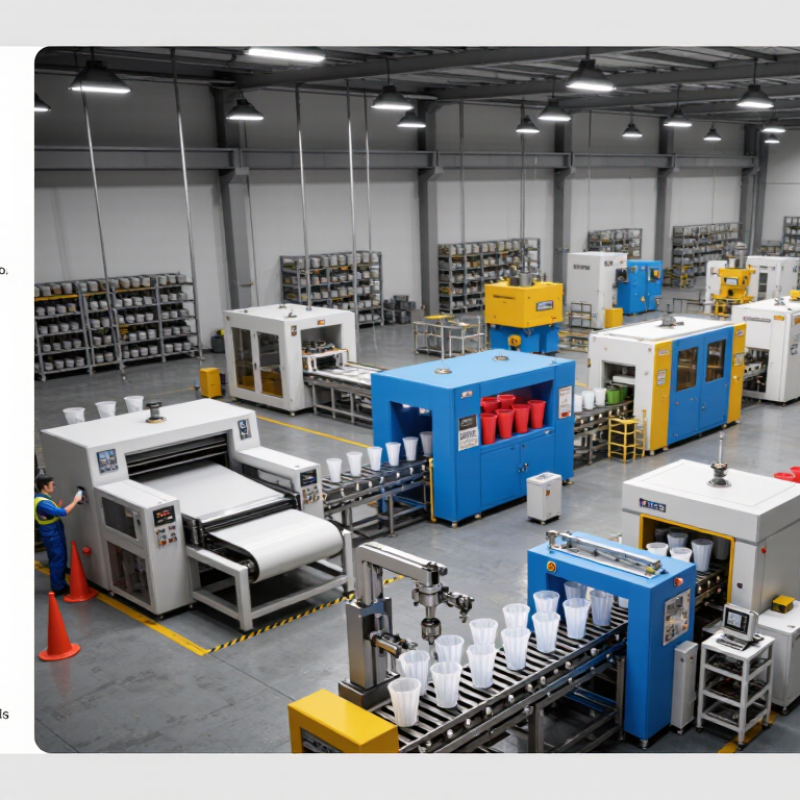
Plastic cup machines differ mainly by forming method, feeding system, and automation level. The ten common types include vacuum forming, pressure forming, thermoforming, injection molding, sheet-fed, roll-fed, rotary, inline, servo-driven, and hydraulic machines. Vacuum systems pull heated plastic sheets over molds. Pressure forming adds compressed air for sharper rims and textures. Thermoforming machines heat sheets, shape cups, trim edges, and stack finished products in one production flow.
Injection molding creates cups from molten resin inside precision molds. It suits thicker walls and repeated dimensions. Sheet-fed machines handle pre-cut plastic sheets, while roll-fed models reduce manual loading during continuous production. Rotary machines support multiple forming stations. Inline systems connect forming, cutting, inspection, and stacking. Servo-driven equipment improves motion control and reduces material waste. Hydraulic models remain practical where high forming force matters, although energy use may require closer review.
Fortune Business Insights valued the global plastic packaging market at USD 430.90 billion in 2023. Smithers also identifies lightweight packaging and automated forming as major development directions. These figures support continued investment, but they do not guarantee profitability. Actual performance depends on cup diameter, wall thickness, resin behavior, mold cooling, and operator skill. A machine advertised as “high speed” may lose efficiency during frequent mold changes. The classification is useful, but not perfect. Production trials still matter.
| No. | Machine Type | Main Forming Principle | Common Materials | Main Functions | Typical Cup Applications | Indicative Production Characteristics | Key Advantages and Considerations |
|---|---|---|---|---|---|---|---|
| 1 | Roll-Fed Thermoforming Machine | Feeds a continuous plastic roll, heats the sheet, forms cups in a mold, then trims and discharges them. | PP PS PET PLA | Heating, plug or vacuum forming, cutting, stacking, scrap collection and automatic conveying. | Disposable drinking cups, yogurt cups, dessert containers and portion cups. | Usually suited to continuous, high-volume production. Output depends on mold cavities, cycle speed, cup size and material thickness. | High material utilization and automation. Requires accurate sheet control, mold cooling and regular trimming-tool maintenance. |
| 2 | Sheet-Fed Thermoforming Machine | Uses pre-cut plastic sheets that are loaded individually or by an automatic sheet feeder before heating and forming. | PP PS PET ABS | Sheet loading, heating, vacuum or pressure forming, trimming and part removal. | Short and medium production runs, customized cups, laboratory containers and specialty packaging. | Lower-to-medium output compared with continuous roll-fed systems, with production determined by cavity count and cycle time. | Flexible for different sheet sizes and materials. Sheet handling can increase labor, waste and changeover time. |
| 3 | Inline Extrusion-Thermoforming Line | Extrudes plastic sheet directly from resin and transfers it inline to a thermoforming station. | PP PS PET PLA | Resin feeding, plasticizing, sheet extrusion, thickness control, forming, trimming and stacking. | Large-volume production of thin-wall cups and food-service containers. | Provides continuous sheet supply and consistent material thickness. Line speed is affected by extruder capacity, cup geometry and cooling performance. | Reduces intermediate sheet handling and can lower logistics cost. Requires higher initial investment and coordinated process control. |
| 4 | Vacuum Thermoforming Machine | Heated sheet is drawn against a mold by vacuum pressure to reproduce the cup shape. | PS PET PVC PP | Sheet heating, vacuum forming, mold cooling, trimming and product release. | Simple drinking cups, nursery cups, trays and containers with moderate forming depth. | Suitable for relatively simple shapes and economical tooling. Wall-thickness distribution may be less uniform in deep or complex cups. | Simple tooling and lower forming pressure. Detailed features and deep-draw designs may require plug assistance or pressure forming. |
| 5 | Pressure Thermoforming Machine | Uses compressed air above the heated sheet, often together with vacuum, to press the material into the mold. | PS PET PP PLA | Precision heating, pressure-assisted forming, detailed surface reproduction, trimming and stacking. | Thin-wall cups, branded-shape packaging, ribbed cups and containers requiring sharper details. | Produces better definition and more consistent walls than basic vacuum forming. Needs an air compressor, sealed tooling and careful pressure control. | Good for lightweight designs and precise features. Operating energy, tooling and maintenance requirements are generally higher. |
| 6 | Injection Molding Machine | Melts plastic pellets and injects the melt into a closed cup mold, where it cools and solidifies. | PP PS PE Tritan-type copolyesters | Plasticizing, injection, holding pressure, cooling, mold opening and automatic ejection. | Reusable cups, rigid promotional cups, laboratory cups and cups with integrated handles or complex details. | Suitable for repeatable dimensions, thicker walls and complex shapes. Cycle time depends on wall thickness, cooling and mold cavities. | Excellent dimensional accuracy and design flexibility. Mold costs, cooling demand and injection pressure are typically higher than thermoforming. |
| 7 | Injection-Compression Molding Machine | A measured plastic charge is placed or injected into a partially open mold, then compressed as the mold closes. | PP PET PS | Metered melt delivery, mold compression, controlled cooling, demolding and automated handling. | Thin-wall cups, food containers and products requiring low residual stress and good weight control. | Can reduce injection pressure and improve material distribution in thin-wall products. Performance depends strongly on mold design and compression timing. | Useful for lightweight precision parts. The system is more specialized and requires accurate synchronization between injection and mold movement. |
| 8 | Compression Molding Machine | Preheated plastic material or a measured melt charge is placed into a mold and shaped by direct compression. | PP Bioresins Thermoset compounds | Material dosing, preheating, mold compression, cooling, demolding and optional decoration handling. | Selected reusable cups, lightweight food-service cups and products made from heat-sensitive or specialized compounds. | Offers controlled material distribution and can support low-stress thin-wall parts. Production rate and material compatibility depend on the compound and mold design. | May provide lower melt flow requirements than conventional injection molding. Requires consistent dosing and carefully controlled mold temperature. |
| 9 | Stretch-Blow Molding Machine | A preform is reheated, stretched and blown against a mold to create a hollow container or cup-like vessel. | PET PP Copolyesters | Preform heating, axial stretching, air blowing, mold cooling and product ejection. | Lightweight reusable drinkware, clear specialty cups and containers needing high clarity or orientation strength. | Best suited to hollow designs with suitable height-to-diameter ratios. Output depends on cavities, heating efficiency and blowing cycle. | Can deliver strong, lightweight and transparent products. It is less suitable for very open, shallow cup geometries or wide flanges. |
| 10 | Integrated Cup Trimming, Stacking and Packing Line | Receives formed cups and performs secondary operations rather than forming the cup itself. | PP PS PET PLA | Rim trimming, edge inspection, counting, stacking, conveying, bagging and carton packing. | High-volume disposable cups produced by thermoforming or injection molding. | Automation level can range from semi-automatic handling to fully integrated inspection and packaging. Capacity must match the upstream forming machine. | Improves hygiene, counting accuracy and labor efficiency. Incorrect synchronization can cause jams, cup deformation or unstable stacks. |