skip to Main Content

China Best Glass Fiber Felt Aerogel Pack Insulation Sheet?

Choosing the China Best Glass Fiber Felt Aerogel Pack Insulation Sheet is not a simple ranking exercise. “Best” depends on the operating temperature, available space, installation method, and exposure to moisture or vibration. A sheet may look uniform on a sample board, yet behave differently around pipe bends or tight equipment housings. Buyers should compare measured thermal conductivity, thickness, density, and service-temperature data under stated test conditions.

Aerogel pioneer and materials scientist Samuel S. Kistler wrote, “The term aerogel is applied to gels in which the liquid is replaced by gas.” His 1931 paper, “Coherent Expanded Aerogels and Jellies,” helps explain the material’s distinctive porous structure; it does not certify any modern composite. In a Glass Fiber Felt Aerogel Pack Insulation Sheet, the felt provides a flexible support for the aerogel layer. That construction can help with handling and fitting, but its actual performance depends on formulation, manufacturing quality, and installation.

Look closely at product documents. Do they report test methods, temperature ranges, and batch consistency? Ask for samples and inspect cut edges, fiber shedding, and compression recovery. Details matter. A low conductivity figure alone cannot prove suitability for a real project. One useful question is whether the supplier’s data reflects the same thickness and conditions you expect to use. This introduction sets out practical criteria for comparing Chinese suppliers without treating a single specification—or a polished product photo—as proof of quality.
China Best Glass Fiber Felt Aerogel Pack Insulation Sheet?

Definition and Structure of Glass-Fiber-Reinforced Aerogel Pack Sheets

China Best Glass Fiber Felt Aerogel Pack Insulation Sheet?

Definition and Structure of Glass-Fiber-Reinforced Aerogel Pack Sheets

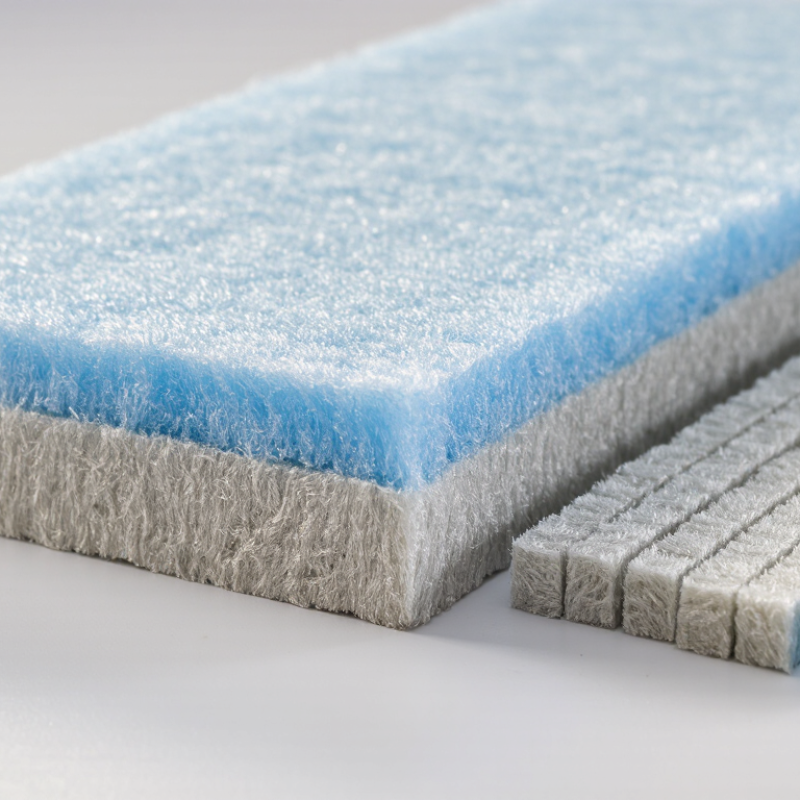
A glass-fiber-reinforced aerogel sheet is a flexible insulating composite, not a solid block of aerogel. Its silica-aerogel particles or network sit within a porous glass-fiber felt. The fibers form a supporting scaffold, helping the brittle aerogel resist cracking during cutting and installation. Look closely at an exposed edge: fine fibers hold the pale, lightweight core together. That is the basic structure.

The 2011 review “Aerogel Insulation for Building Applications: A State-of-the-Art Review,” published in Energy and Buildings, reports silica-aerogel thermal conductivity commonly around 0.013–0.020 W/m·K. Actual sheet performance varies with density, moisture, thickness, and test method. The number is useful, but it is not a guaranteed rating for every reinforced product. Check measured data for the finished sheet.

Some sheets include a facing layer or moisture barrier; others do not. These additions can affect handling, installation, and heat flow. Glass fibers improve integrity, yet they do not make every sheet equally durable. I would inspect cut edges and ask for test results after aging or humidity exposure. A small detail, but an important one: compression at joints can reduce insulation performance in real assemblies.

How Glass Fiber Felt Reinforcement Supports Aerogel Insulation

Aerogel insulation sheets are thin, but their structure can be delicate. Glass fiber felt provides flexible, continuous support. It helps hold the insulation together during cutting, wrapping, and installation. Loose particles are less likely to escape. The felt also makes a lightweight sheet easier to handle around pipes, ducts, and equipment panels. That matters on crowded job sites, where sharp bends and repeated repositioning can damage unsupported material.

Reinforcement does not make a sheet indestructible. The felt distributes handling stress and can help limit cracking or edge fraying, while aerogel remains the main insulating layer. Installers should check the specified thickness, temperature range, and facing before choosing a sheet. Small gaps at seams can reduce the benefit. A snug fit matters.

Glass fiber felt can improve dimensional stability, so sheets are less prone to shifting when secured. Still, performance depends on the full assembly, including compression, joints, moisture exposure, and the insulated surface. I would not treat reinforcement as a substitute for careful installation. That distinction is easy to miss. Compare tested thermal data with actual operating conditions, then verify that the sheet suits the equipment and installation method.

Thermal Conductivity: Typical Aerogel Blankets Reach 0.013–0.020 W/(m·K)

Aerogel insulation is valued for its low thermal conductivity, with typical blanket products measuring about 0.013–0.020 W/(m·K). The exact figure depends on test temperature, sample thickness, density, and measurement method. A lower number can look impressive, but it is meaningful only when the test conditions match the intended use. Check the technical report, not just a product summary.

Glass-fiber felt can reinforce an aerogel sheet and help it hold together during handling and installation. In a real pack, however, seams, fasteners, compression, and small air gaps can affect heat loss. Details matter. A sheet compressed around a sharp corner may not perform like an untouched laboratory sample. I would compare conductivity values at similar mean temperatures and thicknesses, then review how the material will be fitted. Moisture exposure and repeated handling also deserve attention, even when the published figure is strong. No single conductivity value tells the whole story.

China Best Glass Fiber Felt Aerogel Pack Insulation Sheet? - Thermal Conductivity: Typical Aerogel Blankets Reach 0.013–0.020 W/(m·K)

Typical specification guide for glass-fiber-reinforced silica aerogel insulation blankets. Values are indicative, not a product ranking or a guarantee; confirm the test conditions and current datasheet for any specific material.

Specification Typical Information What to Check
Material structure Silica aerogel held in a flexible fibrous reinforcement, commonly glass fiber felt or a similar glass-fiber web. Confirm the reinforcement type and whether the product contains additional facing or binder layers.
Thermal conductivity About 0.013–0.020 W/(m·K) is a commonly reported range for aerogel blanket products. Compare values measured at the same mean temperature and using a stated test method; conductivity generally changes with temperature.
Thickness Several thicknesses are available; 5 mm and 10 mm are common examples, with other options depending on the product. Check actual thickness tolerance and whether the stated thickness is measured under a specified pressure.
Density Varies by formulation, reinforcement, and manufacturing process; there is no single standard density for all aerogel blankets. Request the measured density and its test method when weight or fit is important.
Temperature capability The usable temperature range is product-specific and depends on the aerogel, reinforcement, facings, and operating conditions. Use the manufacturer’s continuous and short-term temperature ratings for the complete composite, not the aerogel alone.
Water behavior Some silica aerogel blankets are made to be hydrophobic; moisture resistance is not identical across all products. Check water-repellency data and whether seams, cuts, or exposed edges need protection.
Handling and installation Flexible blanket formats can be cut and fitted around many curved or irregular surfaces. Follow the product’s installation and dust-control guidance; use suitable personal protective equipment when cutting or handling.
Common applications Industrial pipes, tanks, equipment, and other locations where thin insulation or space efficiency is useful. Confirm suitability for the operating temperature, substrate, environment, and applicable safety requirements.
Thermal test methods Common methods for insulation materials include ASTM C177 and ASTM C518; the method used should be reported with the result. Compare results only when test method, temperature, specimen conditioning, and reporting basis are clear.

Note: “Best” depends on the required conductivity, temperature rating, thickness, moisture exposure, installation conditions, and verified test data.

How ASTM C177 Measures Insulation Performance in Pack Sheets

China Best Glass Fiber Felt Aerogel Pack Insulation Sheet?

How ASTM C177 Measures Insulation Performance in Pack Sheets

For a glass-fiber felt aerogel pack sheet, a low thermal conductivity value sounds impressive. But the test method behind that number matters. ASTM C177 measures steady-state heat flow through a specimen placed between controlled hot and cold plates. A guarded section limits edge losses, helping researchers calculate thermal transmission under defined laboratory conditions. The standard describes a measurement method, not a pass-or-fail rating for insulation products.

A review by Baetens and colleagues in Energy and Buildings (2011) reported thermal conductivity values of about 0.013–0.020 W/(m·K) for aerogel insulation materials. This range offers context, not a guaranteed result for every felt composite. In practice, ask for the tested sheet’s thickness, mean temperature, conditioning, and measured conductivity. Compression can change the thickness; gaps around a pack can also weaken real-world performance. Small details matter.

C177 results are most useful when comparing specimens tested under similar conditions. They do not automatically predict performance in a finished pack, where seams, moisture, and installation pressure can differ. That limitation is easy to overlook. I would also check whether the report identifies the exact sample construction, rather than just “aerogel felt.” A clear test record makes the number more useful, though it still cannot capture every field condition.

China Best Glass Fiber Felt Aerogel Pack Insulation Sheet? How ASTM C177 Measures Insulation Performance

Illustrative calculation, not ASTM test results: The bars show thermal resistance calculated as thickness divided by an assumed thermal conductivity of 0.020 W/(m·K). ASTM C177 measures steady-state heat flow through a specimen to determine thermal transmission properties; actual sheet performance must be measured under specified test conditions.

Battery-Pack Selection: Compare Thickness, Temperature Range, and Compression Strength

Choosing a glass-fiber-felt aerogel insulation sheet for a battery pack means matching thickness, temperature range, and compression strength to actual conditions. Thickness affects heat transfer, but it also uses valuable clearance near cells, wiring, and the enclosure. Measure the tightest gap in the assembled pack, allowing for manufacturing tolerances. Small gaps matter. A thicker sheet is not automatically the safer choice if it interferes with fit or service access.

Check the material’s stated continuous and peak temperature limits, including how long peak exposure is allowed. Compare those figures with expected pack temperatures and nearby heat sources, not just normal operating readings. Leave a margin for uneven heating and measurement uncertainty. Do not guess. Test the complete assembly where possible, since joints, edges, and compression can change how heat travels.

Compression strength needs careful interpretation: a value is meaningful only with its test method and deformation level. Too much pressure may reduce thickness or damage the felt; too little can leave gaps that weaken insulation. Ask for data on compression recovery and performance after thermal cycling. One assumption deserves a second look: drawings rarely capture every fit issue. A prototype can reveal what a specification sheet cannot.

Back To Top
