 skip to Main Content

What Is the Best 3D Printer Filament in 2026?
What Is the Best 3D Printer Filament in 2026? The practical answer depends on the part, printer, and conditions it must withstand. A desk organizer and an outdoor bracket have different needs. The right spool is not always the strongest or cheapest.
The market is expanding, but its scale needs context. Wohlers Report 2025 estimated the broader additive manufacturing industry reached $21.9 billion in 2024, growing 9.1% year over year. That figure covers more than filament, so it should not be mistaken for a filament-market estimate. Still, it shows why material choice matters to a growing range of makers and manufacturers.
Terry Wohlers, founder of Wohlers Associates and a longtime additive manufacturing analyst, has emphasized matching the technology to the application. A fair paraphrase of that guidance is: “Choose for the application, not the hype.” For filament, that means comparing PLA’s easy handling with PETG’s tougher everyday performance, or considering ASA when outdoor exposure matters. Check the printer’s temperature limits, too. A spool label cannot override a machine’s capabilities.
Small details count. Damp filament may hiss, bubble, or leave a rough surface; a sealed bag and desiccant can help. And no chart settles every spool. This guide compares 3d Print Filament options by printability, strength, heat resistance, cost, and practical trade-offs, while noting where evidence is limited. The goal is a defensible choice—not a universal winner.
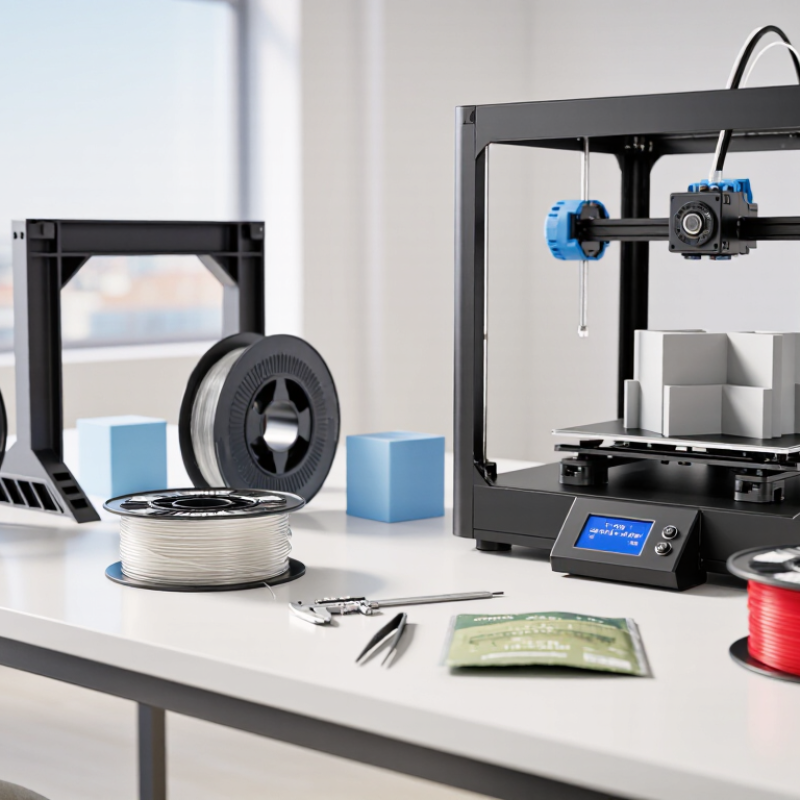
How 3D Printer Filament Is Defined and Classified
A 3D printer filament is a continuous thermoplastic strand supplied on a spool. The printer’s feed system pulls it toward a heated nozzle, where it softens and is laid down in thin lines. Those lines cool and bond into a part. Not quite every spool behaves alike.
Filament is classified by its base material, physical properties, and intended printing conditions. Common material families include PLA, PETG, ABS, nylon, and flexible thermoplastic elastomers. Each offers different trade-offs in stiffness, impact resistance, heat tolerance, and ease of printing. A rigid material may suit a small bracket, while a flexible one can bend around a cable. Details matter.
Filament may also be described by diameter, color, or added particles such as wood-like or mineral fillers. These labels do not guarantee identical performance: formulation and storage can change how a spool prints. Moisture-sensitive materials may need drying, and filled filaments can wear a standard nozzle faster. Check the printer’s supported diameter and temperature range before choosing. “Best” depends on the part, the printer, and the conditions it must handle; even a well-matched material can disappoint when settings or storage are off.
| Filament | Classification | Typical Nozzle Temperature | Typical Bed Temperature | Key Characteristics | Best-Suited Uses | Main Considerations |
|---|---|---|---|---|---|---|
| PLA | Standard thermoplastic; commonly derived from renewable feedstocks | 190–220°C | 0–60°C | Easy to print, low warping, good detail and a broad range of colors | Prototypes, models, display pieces and general-purpose prints | Less suitable for sustained heat or high-impact service; properties vary by formulation |
| PETG | Glycol-modified polyester thermoplastic | 230–250°C | 70–90°C | Good layer adhesion, toughness and moisture resistance | Functional parts, containers and outdoor items with moderate demands | Can string; strong bed adhesion may make removal difficult. Not automatically food-safe after printing |
| ABS | Engineering thermoplastic | 230–260°C | 90–110°C | Tough, impact-resistant and more heat-tolerant than PLA | Housings, mechanical parts and components that may need post-processing | Prone to warping; an enclosed printer and effective ventilation are recommended |
| ASA | Weather-resistant styrenic engineering thermoplastic | 240–270°C | 90–110°C | Good UV and weather resistance with properties broadly similar to ABS | Outdoor fixtures, covers and parts exposed to sunlight | Benefits from an enclosure; printing can produce irritating fumes, so provide ventilation |
| TPU | Flexible thermoplastic elastomer | 210–240°C | 30–60°C | Flexible, resilient and resistant to abrasion; available in different hardnesses | Flexible grips, seals, bumpers, protective cases and wearables | Usually prints more reliably at low speed; compatibility depends on the printer's filament path |
| Nylon (PA) | Polyamide engineering thermoplastic | 250–290°C | 70–100°C | Strong, tough and wear-resistant, with useful fatigue resistance | Gears, hinges, functional brackets and parts subject to repeated movement | Absorbs moisture readily; dry storage and, often, filament drying are important |
| Polycarbonate (PC) | High-performance engineering thermoplastic | 260–310°C | 90–120°C | High impact strength and heat resistance when printed under suitable conditions | Durable functional parts and components requiring greater heat tolerance | Requires a capable hot end and heated bed; enclosure and dry filament help reduce warping and print defects |
| Fiber-filled PLA, PETG or nylon | Composite filament containing short carbon or glass fibers | Depends on the base polymer | Depends on the base polymer | Often stiffer and less prone to visible shrinkage than the unfilled base material | Rigid fixtures, lightweight brackets and parts where stiffness matters | Abrasive fibers can wear standard brass nozzles; a wear-resistant nozzle is generally recommended |
How to choose: There is no single best filament for every printer or project. PLA is a practical choice for easy printing and detail; PETG is a versatile option for tougher everyday parts; TPU suits flexible designs; and ASA, nylon or PC may suit more demanding applications when the printer can meet their requirements. Temperature ranges are typical starting points, not universal settings—check the filament's specifications and calibrate for the printer.