2026 Top Vacuum Furnace Heat Treatment Types
Vacuum Furnace Heat Treatment is becoming a critical process for high-performance manufacturing in 2026. It protects sensitive components from oxidation, contamination, and unpredictable surface reactions. In a typical production cycle, parts enter a sealed chamber, air is removed, and controlled heating transforms their structure. Bright metal surfaces matter. So does dimensional stability.
The U.S. Department of Energy reports that process heating represents about 51% of energy use in American manufacturing. This figure explains why furnace efficiency, heat recovery, and accurate temperature control receive increasing attention. The International Energy Agency also emphasizes industrial electrification and efficiency as essential decarbonization pathways. Vacuum furnaces support these goals through electric heating, programmable cycles, and reduced protective-gas consumption.
Industry research presents a growing market, although estimates vary. Grand View Research and MarketsandMarkets both identify aerospace, automotive, medical devices, and energy equipment as important demand sectors. These reports also highlight advances in high-pressure gas quenching, multi-zone control, and smart monitoring. However, market forecasts are not production guarantees. Equipment performance depends on loading patterns, alloy chemistry, maintenance, and operator experience.
That detail is often underestimated.
This 2026 overview examines major vacuum furnace heat treatment types, including vacuum annealing, hardening, tempering, brazing, sintering, and solution treatment. It also considers practical selection factors, such as cooling pressure, achievable uniformity, chamber size, and total operating cost. Reliable results require more than advanced hardware. They require validated recipes, calibrated sensors, documented traceability, and careful review of failed batches. Technology helps. Judgment still matters.
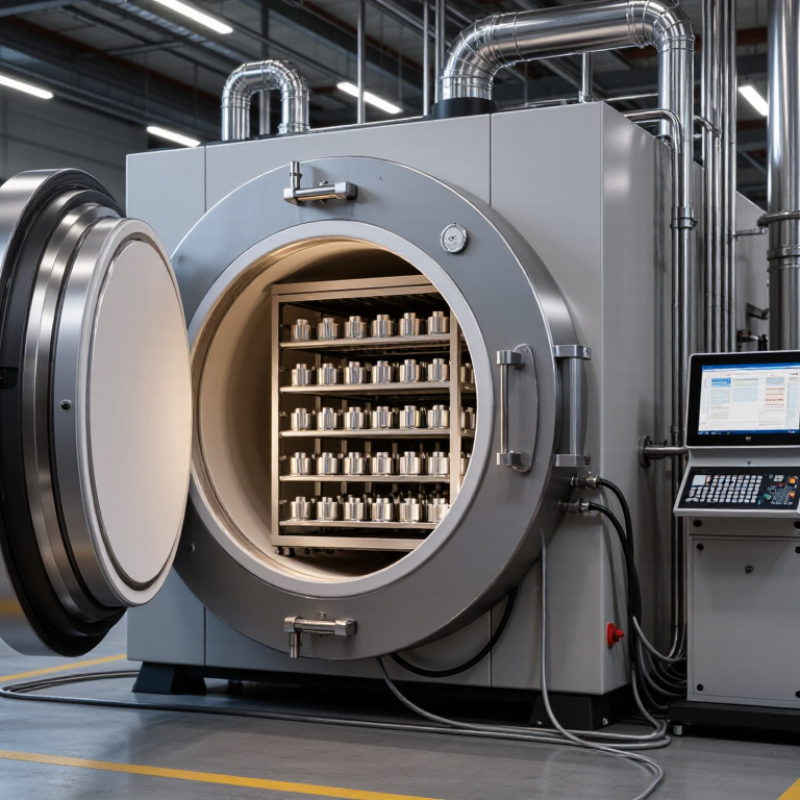
Vacuum Furnace Heat Treatment: Definition and Working Principles
Vacuum Furnace Heat Treatment: Definition and Working Principles
Vacuum furnace heat treatment modifies metal properties inside a controlled, low-pressure chamber. Pumps remove oxygen, moisture, and contaminants before electric heating begins. This reduces oxidation, scaling, and surface decarburization on steel parts.
The furnace heats components through radiant energy rather than direct flame. Temperatures commonly range from 600°C to above 1,300°C, depending on the alloy and treatment cycle. Operators may perform annealing, hardening, tempering, brazing, or solution treatment. After soaking, the load cools through vacuum radiation, gas quenching, or controlled-pressure cooling. Gas pressure and flow strongly affect hardness and distortion.
The U.S. Department of Energy’s 2022 Industrial Decarbonization Roadmap reports that process heating uses about 51% of industrial energy consumption. The International Energy Agency’s Energy Technology Perspectives 2024 places industry near 37% of global final energy demand. These figures explain the growing focus on furnace efficiency, insulation, leak testing, and heat recovery.
Clean surfaces are not guaranteed. Poor loading, trapped oil, or unstable gas pressure can still produce uneven results. That assumption is convenient, but incomplete. In practical work, thermocouple placement and cooling uniformity often matter as much as the programmed temperature. ASM Handbook guidance also emphasizes atmosphere control and verified thermal uniformity for repeatable metallurgical outcomes. A cycle can look correct on the screen and still fail inspection.
Key Factors for Classifying Vacuum Heat Treatment Types
Classifying vacuum heat treatment types starts with process purpose, not furnace appearance. A technician may select vacuum annealing to relieve stress. Vacuum hardening can increase wear resistance. Vacuum tempering balances hardness and toughness. Brazing and sintering belong to different process families, even when they use similar chambers. The material changes the classification too. Tool steel, titanium, and nickel alloys require different temperature ranges, soak times, and cooling rules. Small details matter.
Vacuum level is another practical factor. Low pressure reduces oxidation, while high vacuum supports cleaner surfaces and lower contamination risk. Yet pressure alone does not define a treatment. Gas type, gas purity, cooling pressure, and cooling speed can separate one hardening method from another. A load cooled in flowing inert gas behaves differently from one cooled slowly inside the hot zone. Technicians should record thermocouple positions, load weight, and part spacing. A crowded basket can create uneven hardness.
The final classification should consider the required result and the evidence behind it. Hardness testing, metallographic checks, dimensional inspection, and furnace records make the process defensible. Standards help, but they cannot replace sound judgment. In daily work, one cycle may combine heating, soaking, gas quenching, and tempering. That makes simple labels imperfect. I have seen “vacuum hardening” hide major differences in cooling performance. Reviewing the actual recipe is safer than trusting the name. Even a well-controlled cycle deserves another question: did the center of the load receive the same treatment as the surface?
Vacuum Annealing, Stress Relief, and Softening Treatments
Vacuum furnace heat treatment supports clean, controlled changes in metal performance. Vacuum annealing reduces hardness and improves ductility after forming or machining. The low-pressure environment limits oxidation, so surfaces remain cleaner and easier to inspect. This matters for stainless steels, tool steels, nickel alloys, and precision components.
Annealing schedules depend on alloy chemistry, section thickness, and previous processing. A typical cycle includes controlled heating, soaking, and slow cooling. Temperature uniformity must be verified near the actual load, not only at the furnace sensor. Small parts may finish early, while thick sections still hold internal heat. That difference can affect hardness and dimensional stability.
Stress relief treatment removes residual stress without fully softening the material. It is useful after welding, grinding, cutting, or heavy machining. Careful ramp rates help reduce distortion, especially in thin or uneven parts. Softening treatments use higher temperatures or longer holding times when easier machining is required. Hardness testing before and after treatment provides practical evidence of process control. A perfect recipe on paper can still fail in production. In my experience, load spacing and cooling behavior deserve more attention than many process sheets receive. Verification should include furnace records, calibrated instruments, hardness results, and visual checks for discoloration or distortion.
2026 Top Vacuum Furnace Heat Treatment Types
Representative processing temperature ranges for common steel applications: vacuum annealing, stress relief, and softening treatments.
Vacuum annealing generally uses the highest temperature range to reduce hardness and improve machinability. Stress-relief treatment is typically performed at a lower temperature to reduce residual stresses without substantially changing the material structure. Softening and spheroidizing treatments use controlled heating and cooling to improve ductility and cutting performance. Actual temperatures depend on steel grade, section size, prior processing, and required properties.
Vacuum Hardening, Quenching, and Tempering Processes
Vacuum hardening begins with controlled heating inside a low-pressure chamber. The process limits oxidation, so finished parts often need less cleaning afterward. For tool steels, technicians select an austenitizing temperature based on grade, geometry, and prior condition. Soak time matters. Too little heat leaves soft cores, while excessive heat can enlarge grains and reduce toughness.
After heating, quenching removes heat quickly enough to form martensite. Many vacuum furnaces use high-pressure nitrogen or argon gas. The correct choice depends on steel chemistry and section thickness. Gas flow must reach hidden edges, holes, and heavy sections. Otherwise, hardness may vary across one component. In production reviews, distortion is sometimes blamed on quenching when uneven loading caused the real problem. Parts should be supported carefully and tested at several locations.
Tempering follows quenching, often in one or more controlled cycles. It reduces brittle stresses and adjusts hardness for actual service conditions. A high hardness reading is not automatically a successful result. Engineers should review hardness, microstructure, dimensional change, and fracture risk together. Temperature sensors, pressure records, and calibrated test equipment improve process reliability. The difficult part is choosing a cycle that survives real loads, not merely passing a reference chart. That choice sometimes needs revision.
 skip to Main Content
