2026 Top Granite Air Bearings Types What Global Buyers Need?
In 2026, granite air bearings remain essential for buyers demanding frictionless motion, thermal stability, and nanometer-level positioning. They support inspection systems, semiconductor tools, coordinate measuring machines, and precision machining platforms. Yet the word “air bearing” hides important differences. Porous-media, orifice-restricted, vacuum-preloaded, radial, and thrust designs behave differently under load.
Alexander H. Slocum, a respected precision-machine designer, expresses the central engineering principle: “Precision is a system result, not a component promise.” This idea matters when selecting granite air bearings. A polished granite surface cannot rescue poor air preparation, unstable temperature control, or an undersized stiffness specification. Small details matter. Micron-level flatness. Clean, dry air. Controlled preload.
Global buyers should compare load capacity, stiffness, damping, flow consumption, flatness, mounting geometry, and service support. They should also check whether performance data comes from laboratory testing or real production conditions. That distinction is often overlooked. A bearing rated for static load may perform poorly during acceleration, vibration, or uneven thermal expansion.
This guide examines the leading granite air bearings types expected to influence purchasing decisions in 2026. It connects bearing structure with application demands, ownership cost, and supplier reliability. The discussion is practical, not absolute. Some specifications remain difficult to compare across manufacturers. Buyers should request test methods, tolerance drawings, air-quality requirements, and application references before approving a design. The best choice is rarely the cheapest unit. It is the one that stays stable when the machine, factory, and operating conditions become less than perfect.
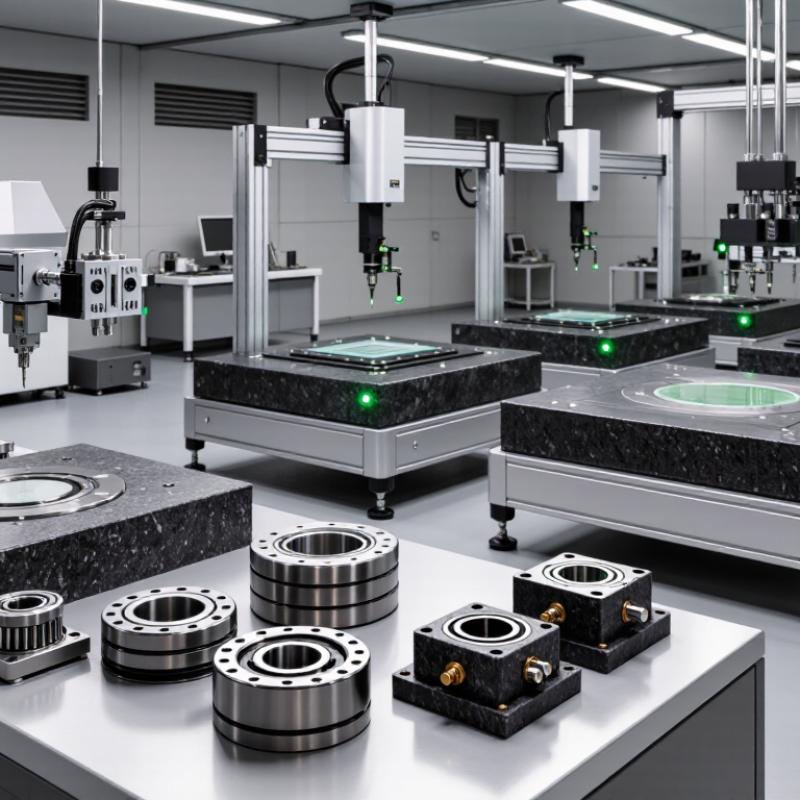
Granite Air Bearings Explained: 5–50 μm Air Films and Submicron Motion
Granite air bearings support motion on a controlled air film, usually between 5 and 50 μm thick. The granite surface provides stiffness, thermal stability, and a low-wear reference plane. Common designs use porous media or precision orifices to distribute clean, regulated air. Some systems add vacuum preload, improving resistance to lift and side forces.
Submicron motion depends on more than the bearing gap. Air pressure stability, granite flatness, carriage mass, vibration, and temperature all affect performance. A 10 μm film does not automatically deliver 0.1 μm positioning. That assumption is often too neat. Practical verification should include interferometer readings, repeatability tests, and measurements under real payloads. Contamination can also change the air layer quickly.
Tips: Check the specified film thickness at operating pressure, not only at idle pressure. Use filtered, dry air and inspect the supply line regularly. Confirm whether the quoted accuracy means resolution, repeatability, or true positioning accuracy. These terms are not interchangeable. Buyers should also ask for load capacity, stiffness data, warm-up conditions, and installation tolerances. A stable laboratory result may shift on a factory floor. Small thermal gradients can matter.
Porous-Carbon, Orifice-Restricted, and Hybrid Granite Bearing Types
2026 Top Granite Air Bearings Types What Global Buyers Need?
Porous-Carbon, Orifice-Restricted, and Hybrid Granite Bearing Types
Granite air bearings combine a stable stone surface with a thin, controlled air film. ASTM C615 data places granite density near 2.63–2.75 g/cm³, supporting rigid metrology platforms. Porous-carbon bearings release air across many microscopic paths. They provide smooth support and tolerate small surface variations. Orifice-restricted bearings use drilled passages and precision restrictors. They can deliver higher stiffness, but contamination becomes a serious concern. The choice is not always obvious.
Hybrid bearings combine both methods. Porous carbon can support uniform airflow, while orifices improve load control in selected zones. This design suits coordinate measuring machines, optical stages, and semiconductor inspection tables. In practice, buyers should check thermal drift, load capacity, air consumption, and granite flatness together. A bearing may look efficient on paper, yet perform poorly with unstable plant air. The U.S. Department of Energy reports that compressed air commonly consumes 10–15% of industrial electricity. Its compressed-air assessment also notes that leaks may waste 20–30% of output. Those figures make restrictor design and leak testing commercially important.
Tips: Request measured stiffness curves, not only catalog values. Confirm airflow at working pressure. Ask for surface-flatness records and filter specifications. ISO 8573-1 air-quality classes help define particle, water, and oil limits. I would also test the assembly under real temperature changes. Laboratory perfection can mislead. Installation habits matter more than many buyers admit.
How to read this chart: The scores are comparative engineering indices from 1 to 5, based on the operating principles of each bearing architecture rather than brand-specific test data. Porous-carbon bearings provide distributed air flow and good damping, orifice-restricted bearings offer strong stiffness and precise flow control, while hybrid designs combine both approaches. Actual performance depends on bearing size, air pressure, surface flatness, load, and contamination control.
Linear, Rotary, and Thrust Designs: Accuracy from 0.1 to 1 μm
In 2026, global buyers are comparing granite air bearings by motion type, not appearance. Linear, rotary, and thrust designs serve different precision requirements. Each design depends on stable air pressure, clean filtration, and accurate granite machining. A polished surface alone cannot guarantee reliable movement.
Linear air bearings guide stages along a straight path. They suit inspection systems, semiconductor tools, and laboratory positioning tables. Rotary air bearings support smooth angular motion with minimal friction. They require careful attention to radial error, runout, and encoder alignment. Thrust bearings carry vertical loads between parallel granite surfaces. They are useful for wafer handling, metrology platforms, and precision indexing.
Accuracy claims from 0.1 to 1 μm need careful interpretation. A 0.1 μm result may describe repeatability under controlled conditions. It may not represent total machine accuracy during production. Thermal drift, vibration, air turbulence, and uneven loading can quickly affect results. Small details matter. A buyer should request test methods, load data, operating temperature, and long-term stability records.
Experienced engineers also check installation requirements before ordering. Air must remain dry and consistent. Granite supports need proper leveling and isolation from floor vibration. The specification is rarely perfect. Real performance can differ after integration, especially when cables, motors, or heavy fixtures add resistance. A practical acceptance test should measure straightness, motion error, settling time, and repeatability on the final machine.
Key Buyer Metrics: Load, Stiffness, Flow, Runout, and 20–25°C Stability
Granite air bearings support ultra-low friction motion, but buyers should compare operating data, not polished catalog claims. The U.S. Department of Energy’s Improving Compressed Air System Performance guidance reports that compressed air can consume about 10% of manufacturing electricity. Flow efficiency therefore affects both operating cost and facility capacity. Request flow in standard liters per minute at the stated pressure and load. Ask for leakage data, too. Small leaks become expensive.
Load capacity must match the real preload, orientation, and safety margin. Stiffness should be reported in both vertical and lateral directions, preferably in N/µm under defined pressure. Static stiffness alone can mislead. Dynamic behavior matters during acceleration and reversal. Runout should include radial and axial values, measurement speed, probe resolution, and filtering. ISO 230-2:2014 provides a useful framework for positioning performance and repeatability tests. Use comparable test conditions.
Temperature control deserves equal attention. A buyer should request displacement data across 20–25°C, with warm-up time, humidity, and granite temperature recorded. NIST measurement guidance stresses uncertainty budgets, yet suppliers sometimes omit thermal uncertainty. That omission deserves scrutiny. A five-degree sweep can reveal drift hidden in a single-room test. My practical preference is a witnessed test using the buyer’s payload and duty cycle. Perfect repeatability on a light fixture proves little. Even experienced teams can understate flow variation when regulators, tubing, and restrictors are tested separately.
2026 Global Selection Guide: Materials, ISO 230 Testing, and Lifecycle Cost
2026 Top Granite Air Bearings Types What Global Buyers Need?
For 2026 projects, granite air bearings should be selected by application, not appearance. Natural granite offers strong damping, thermal stability, and a rigid reference surface. Ceramic or composite options may reduce mass, but they can raise machining and replacement costs. Buyers should request material certificates, surface-flatness maps, and load data at operating pressure.
ISO 230-2:2014 provides a recognized method for testing positioning accuracy and repeatability on machine tools. It does not replace bearing-specific tests. Ask suppliers to report drift, straightness, repeatability, and thermal behavior under realistic duty cycles. The U.S. Department of Energy notes that compressed-air systems can consume 10–30% of industrial electricity. Therefore, leakage, filtration, pressure, and compressor loading belong in lifecycle-cost calculations. ISO 8573-1 air-quality classes can help define filtration requirements.
Tips: Compare five-year energy, service, calibration, and downtime costs. Measure air consumption at the actual load. Do not trust a single catalog value. A perfect first specification is uncommon. Humidity, dust, and uneven installation often expose hidden weaknesses. I would also repeat ISO 230 testing after installation, because transport and foundation settling can change results. The cheapest granite bearing may become expensive when cleaning intervals shorten or metrology time increases. Include spare filters, inspection labor, and recalibration in the purchase model.
 skip to Main Content
